On Nov. 30 of last year, I ran my slowest marathon to-date. When I crossed the finish line of the Space Coast Marathon, I finished my 19th marathon in my 14th state, and while I wasn’t pleased with my time, I was still proud of another marathon finish. It was a hot, sunny day, which happens when you choose a marathon in Florida, but I didn’t like how early I started to struggle, and I knew I had more in me.
The next day, I signed up for marathon number 20 and state number 15 — the Tobacco Road Marathon in Cary, North Carolina. I’d originally heard about the race years ago when it was a BibRave partner race. It seemed like it would be pretty flat, and it was a reasonable driving distance from my home in Salisbury, Maryland. I would also already be training for the Algonquin 50K in February, so I wouldn’t need to do an entire new training cycle.
The Space Coast Marathon was too hot and the Algonquin 50K was too cold — I was hoping the weather would be just right for this one.
I didn’t quite meet my goal of beating my 5:29:17 time from the Atlanta Marathon in 2020, a faster time from the last several years (my PR of 4:17 from 2013 and a 2019 time of 4:50 are out-of-reach at this time). However, I did have a strong race at the Tobacco Road Marathon, with a time that was about half-an-hour faster than my time at the Space Coast Marathon.
I left for the Research Triangle area of North Carolina the day before the race — Saturday morning, March 14. Google Maps says it takes about five hours and 43 minutes to get from my house to the packet pickup location, and with stops for lunch and gas, it took a little longer. However, it was a pleasant drive, and I made it to packet pickup at the USA Baseball National Training Complex a little after 4 p.m., before it closed at 5 p.m. There was a small expo, and packet pickup was quick and easy. In addition to the bib, I received a tech shirt and socks.
Communication was great leading up to the race, and I knew when I registered that there would not be parking available on-site. There was information about catching a free shuttle from a satellite parking lot, and that parking lot was only about a 10-minute drive from my hotel, the TownePlace Suites Raleigh-Durham Airport/Morrisville. I don’t always shout-out the hotel where I stay, but this hotel was convenient and clean, and I felt like it was a great value.
One thing I noticed about the Research Triangle area was that everything I wanted to do and see was relatively spread out; it was definitely important to have a car. I had asked for area recommendations on the 50 States Marathon Club Facebook group and got some fun suggestions. I also noticed there were housing developments everywhere — more than I usually see.
After I checked into my hotel, I drove to and walked around Dorothea Dix Park in Raleigh, where I saw the Thomas Dambo Trolls and other art, before dinner at Trophy Brewing & Pizza nearby.
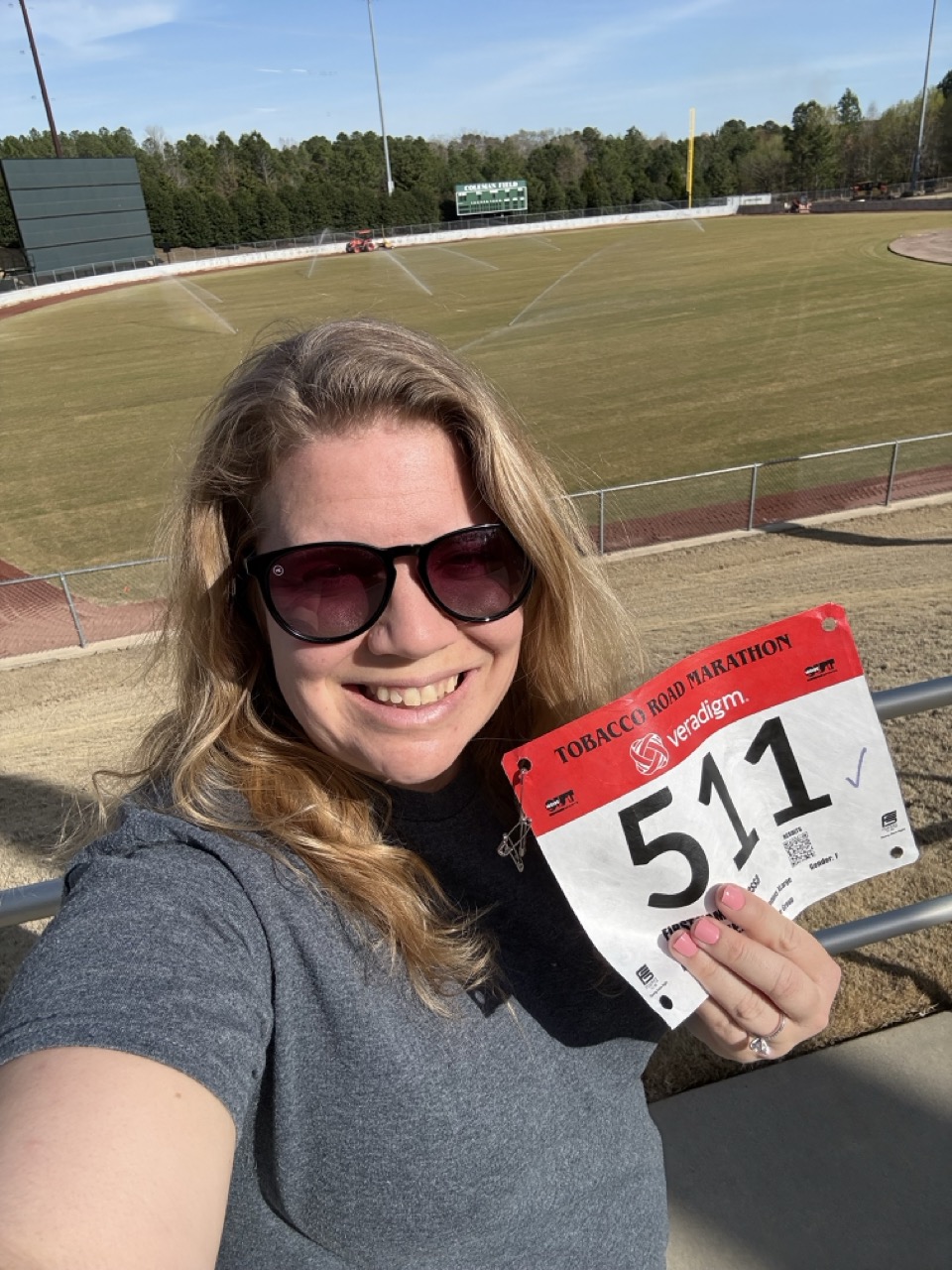
Race morning, March 15, started early. It was recommended to get to the shuttle location by 5 am, and I got there several minutes after 5 — still early in the morning. I followed the other runners and ended up walking right onto a bus; there was no line. Our bus driver actually got lost on the way, but luckily, we had plenty of time to spare.
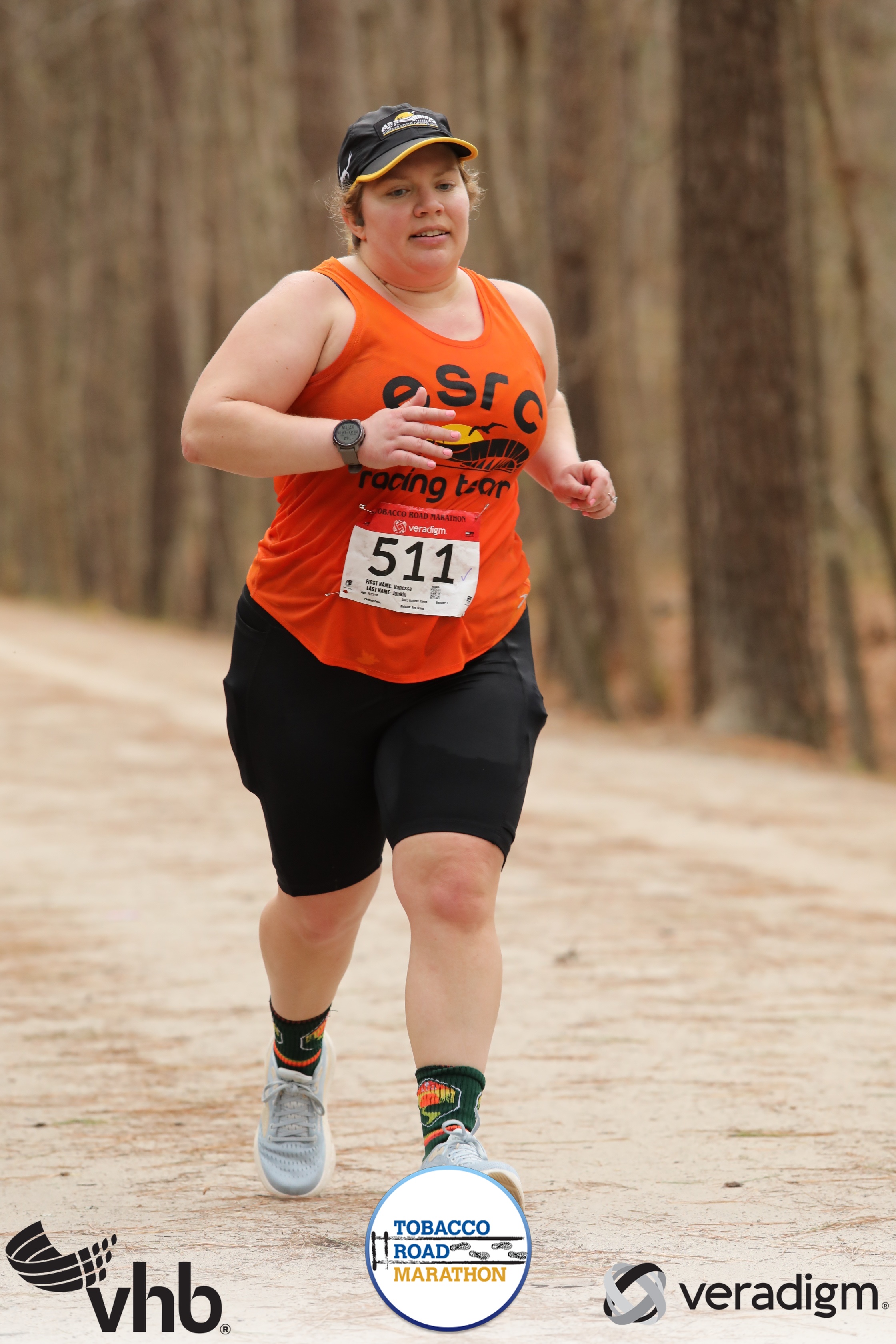
It was a little chilly out before the race began; I think it was in the upper 40s. I wore my Eastern Shore Running Club singlet, hat and shorts. I knew it was expected to get warmer later on.
The race began at 7 am. I lined up by the 5:30 pacers, Jennifer and Laurie, who were amazing, motivating and encouraging. I let them know before we started that I hoped to stay in front of them, and I was able to do so for much of the race.
I was planning to do run-walk intervals for most of the race, but I figured maybe I would solely run at the beginning, like I did at Space Coast and Algonquin. However, there was a significant uphill pretty early on, so I ended up taking one of my walk intervals. I had programmed four-minute run, 45-second walk intervals into my intervals app, and I also listened to my the Spotify playlist I’d made for the Algonquin 50K using my Shokz, pausing it if I wanted to listen to my surroundings or go through a water stop.
The best part about going up this hill was that I knew we would also be returning down the same hill at the end of the race. It was close to 2.5 miles before we made it onto the American Tobacco Trail, where we would run most of the race. This first part took us through Thomas Brooks Park and roads that had the entrances to different neighborhoods.
Upon reaching the trail from Morrisville Parkway, we headed north first. This part of the trail had a paved section and a crushed stone section. The south section was crushed stone.
I was staying on pace and in front of the pacers until I took a bathroom stop during mile 7. Still, this may have been my fastest marathon mile including a bathroom stop, at least recently, as I completed this mile in 13:17 (usually, I end up taking a few extra minutes). I was able to catch them and get back in front of them not too long after the stop; somewhere near the turnaround.
We turned around just before Scott King Road, about 8.5 miles into the race. Then, we headed south on the American Tobacco Trail, past where we had entered the trail. The next turnaround would be almost to mile 19.
I felt good as I continued my run-walk intervals and stayed in front of the pacers. There were times when I was close to them, but they were doing a consistent run (which I also do while pacing), and I knew I wanted to take the walk breaks. Occasionally, I skipped a walk interval.
I made it to the half marathon mark in about 2:42 and change. This was slightly under the time I was going for (2:45 would be half of a 5:30 marathon), but I would have preferred to have a bit larger of a cushion. However, I continued doing my thing. I didn’t carry water and stopped at each water stop. The volunteers were great!
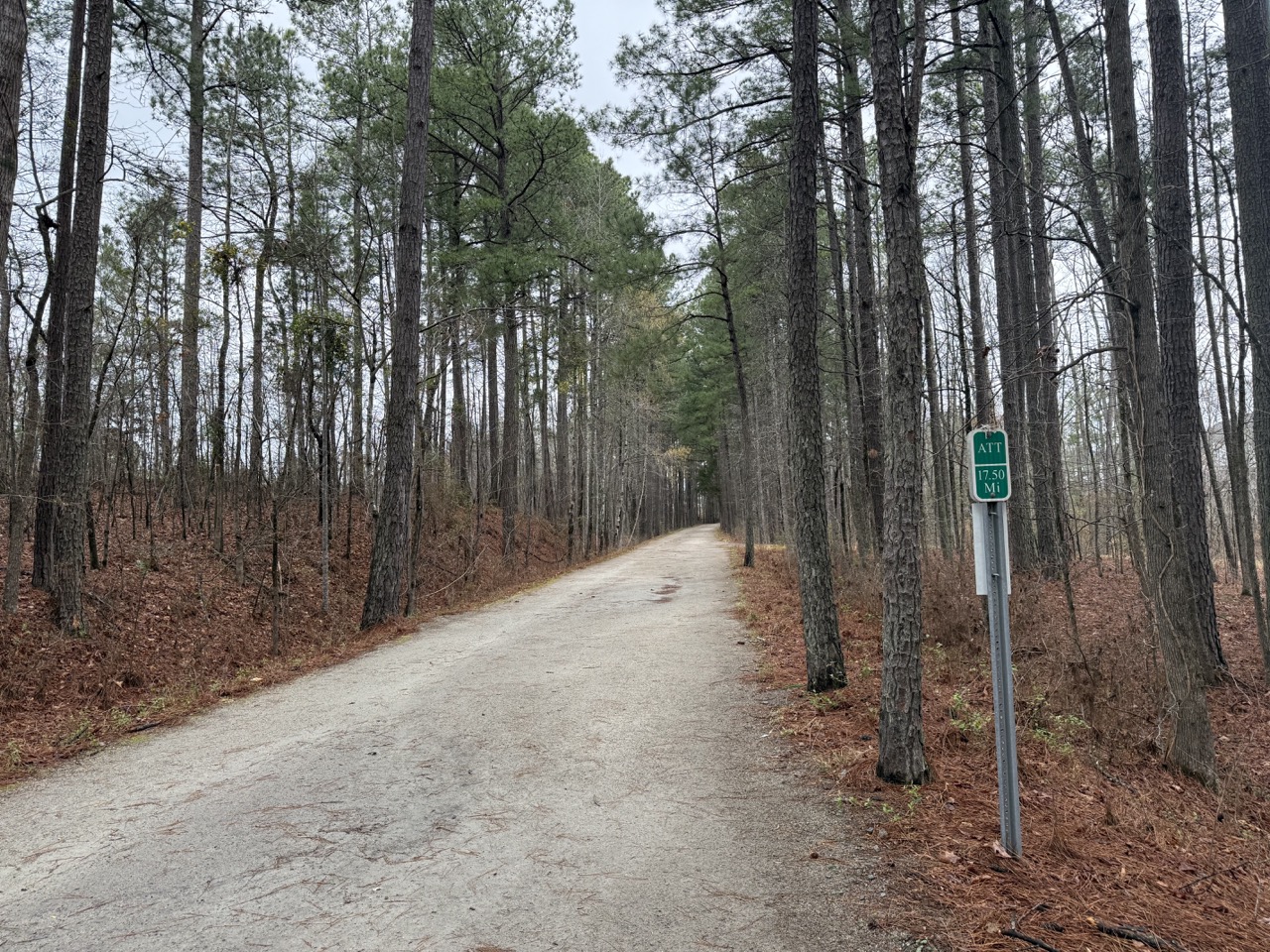
While it wasn’t like the Florida heat, it started to get warm around four hours in, around mile 18 to 19. The trail seemed mostly flat, but there were some sections where I noticed small hills, and there was definitely a lengthy incline heading toward the south turnaround — which I knew would also be helpful on the way back.
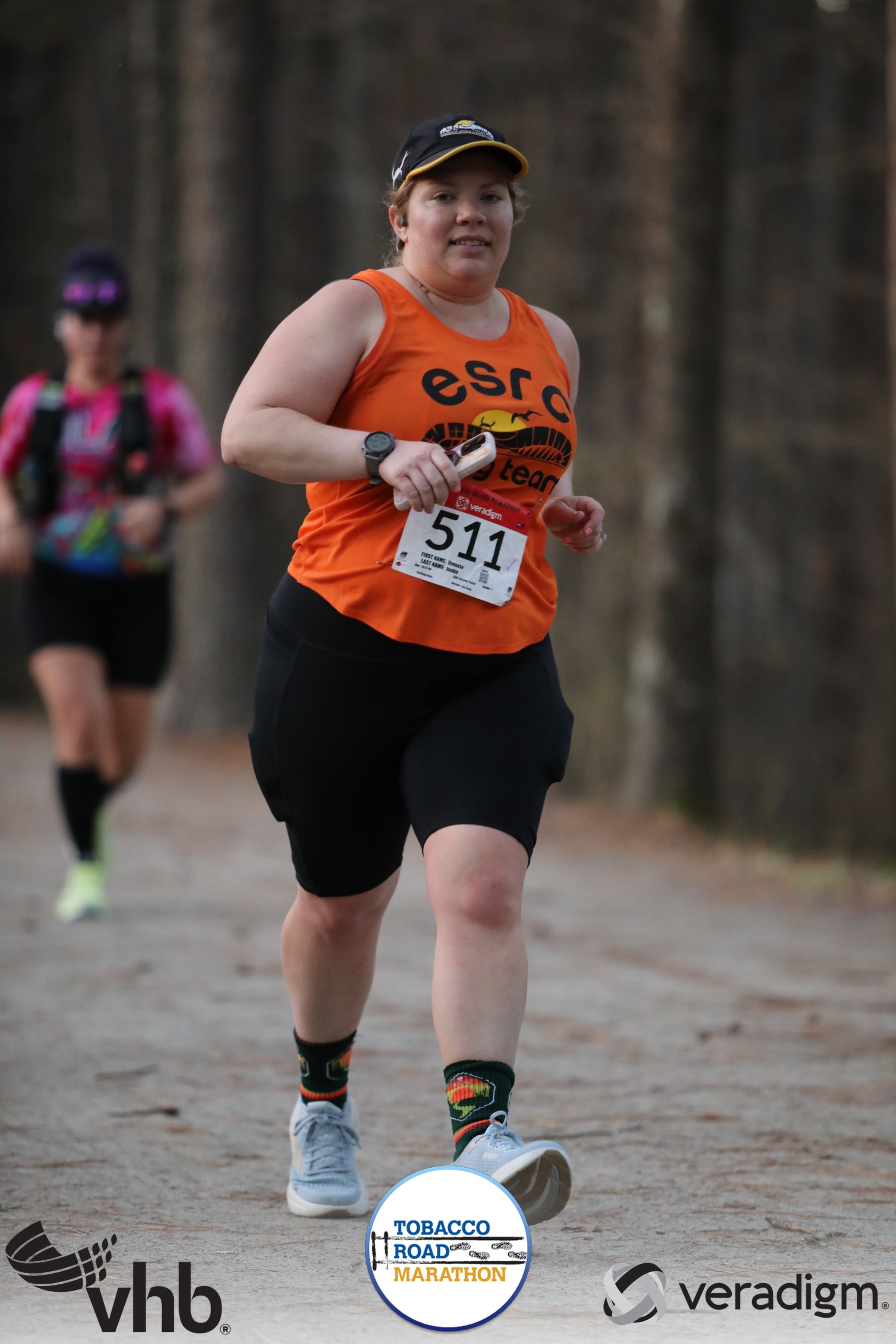
When I turned around, I was about a minute ahead of the pacers, but I wanted to be farther ahead of them. I had started to slow down more around Mile 17.
The pacers passed me around Mile 21, which made me less motivated to hit my time goal. Of course, it wasn’t their fault, but I didn’t think I was going to be able to pick up the pace to stay with or in front of them, as I was starting to struggle more. I really appreciated the shade of the trees on the trail. Whenever we went into a section that didn’t have as much shade — like across a road — I could feel the sun.
Once I was passed, I took extra time to walk. I also changed the settings on my intervals app to two-minute run/30-second walk, and then two-minute run/one-minute walk. Even after I knew I wasn’t going to meet my time goal, I still wanted to do well. I was thinking about my other marathon times, and I knew I’d run 5:47 in 2024, with three slower times since then. I figured coming in under 5:45, especially in the 5:30s, would be nice.
Miles 22 through 24 were my slowest of the day — at 15:24, 14:53 and 14:19, they were the only miles that did not start with a “13” or less — before I picked it up a little in the last couple miles, knowing I was getting closer to the finish and expecting the downhill. However, there were uphills leading to that downhill. The uphills are always much more noticeable, especially after running 24 or so miles.
On the trail, there were green signs that had mile markers every quarter-mile, and although I had my watch, and there were also the race mile markers, I used those to know where I was, as well. Although the courses were different, the fact that we went north and turned around and then went south and turned around was very similar to the course setup for the Space Coast Marathon (aside from the first 2.5-ish out-and-back).
I always struggle in the heat, and I felt like Gatorade could help, so I took orange Gatorade at the last two aid stations, even though I don’t like oranges or anything orange-flavored. I do think it helped! I also ate my Clif Shot Bloks along the way, in addition to drinking water.
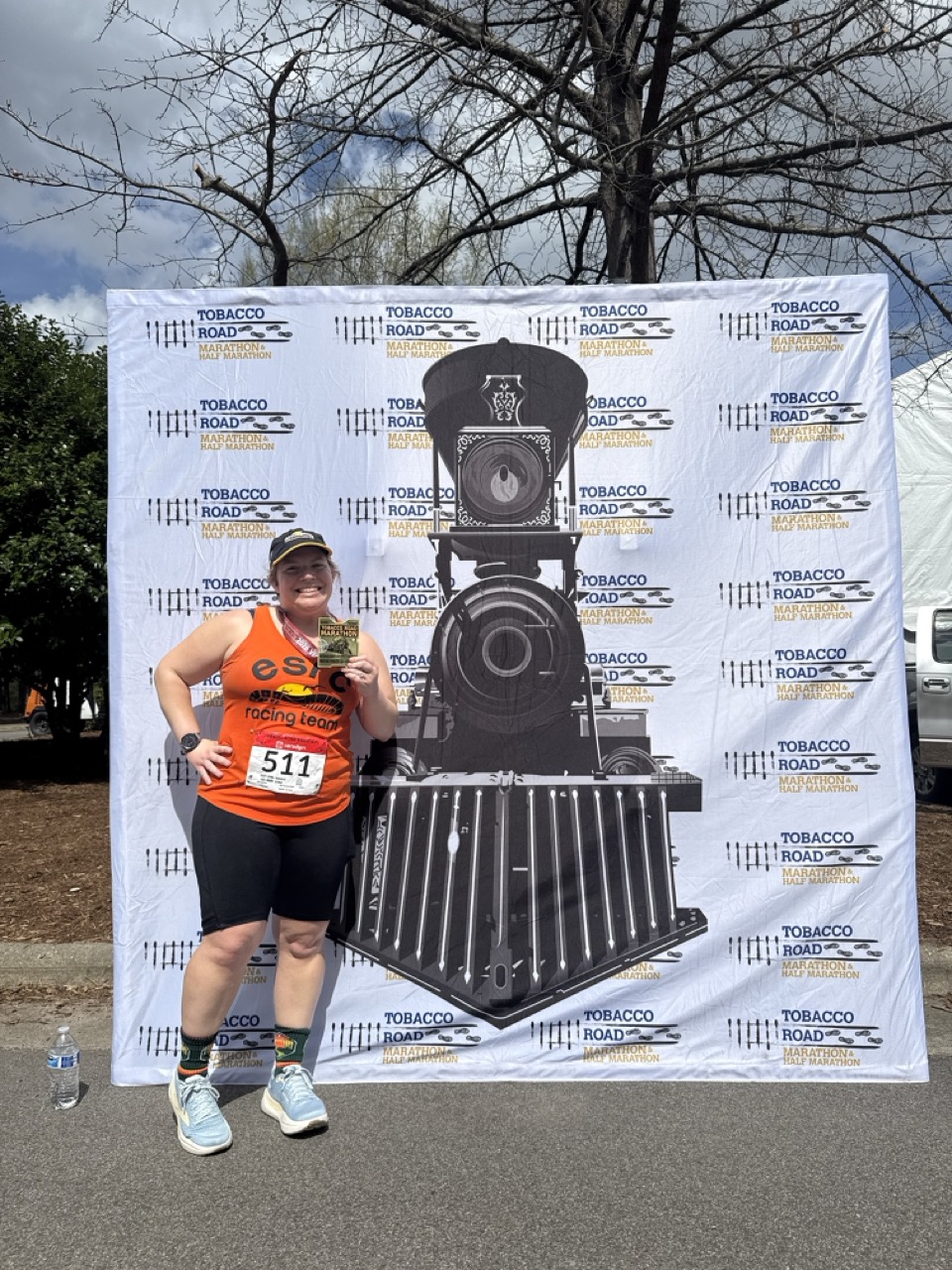
I crossed the finish line with a chip time of 5:36:56, my fastest marathon time since 2023 (of my 20 marathons, I have run three in 5:34 and change). However, when I crossed the finish line, my watch didn’t say 26.2, which is rare. I’m usually well past 26.2 on my watch (sometimes even 26.5 or 26.6!). I ran till my watch passed 26.22, and that time was 5:38:03. I looked at Strava, and others had the full distance, and it’s a certified course, so I figure the trail impacted the GPS reading.
Even though I enjoy pacing half marathons, I usually haven’t really been able to use pace groups. Though I didn’t really run with the group, the pacers motivated me the whole time. I appreciated the fact that there was a 5:30 pace group, and there was a 6:00 one, too. Sometimes races don’t have the pace groups go out to those times.
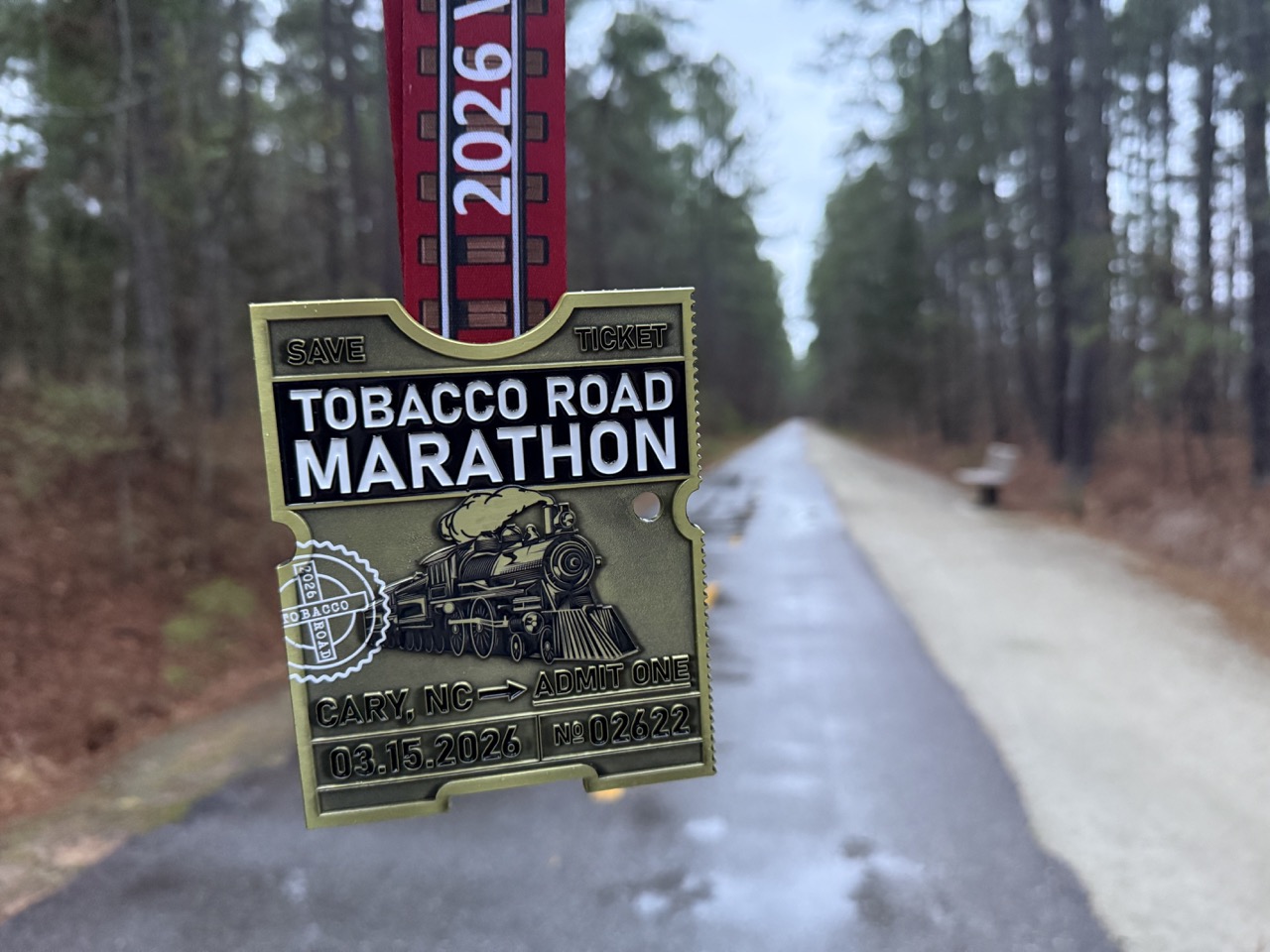
After crossing the finish line, I received my medal and headed to the tent. It wasn’t very crowded, as there was also a half marathon, and most of the marathoners had finished before me (I finished 782nd of 856 in the marathon; there was a seven-hour cutoff). The band was packing up, but I had some local beer from Bond Brothers Brewing Company and some post-race pizza. I took a screenshot of the temperature not long after I finished the race, and the temperature was 72 (it said “feels like” 66).
Then, I headed onto the bus to head back to my car. Later that day, I walked around the Sarah P. Duke Gardens, which were pretty and had cherry blossoms in bloom (yes, I walked more, although slowly!). During my trip, I also enjoyed coffee at Fount Coffee & Kitchen and Land of a Thousand Hills Coffee and food from Lakewood Social, Lawrence Barbecue and Dame’s Chicken & Waffles. All the places I visited were awesome!
I will be getting married this fall and decided not to run any marathons for the rest of the year. So, I’m not sure what marathon 21 will be — and I’m glad that this one went well. I’m already enjoying the break from super-long races.
Splits
Mile 1: 12:34
Mile 2: 11:59
Mile 3: 12:16
Mile 4: 12:18
Mile 5: 12:13
Mile 6: 12:37
Mile 7: 13:16 (bathroom stop)
Mile 8: 12:09
Mile 9: 12:07
Mile 10: 12:18
Mile 11: 12:38
Mile 12: 12:21
Mile 13: 12:15
Mile 14: 12:26
Mile 15: 12:53
Mile 16: 11:59
Mile 17: 12:44
Mile 18: 13:32
Mile 19: 13:14
Mile 20: 12:48
Mile 21: 13:20
Mile 22: 15:24
Mile 23: 14:53
Mile 24: 14:19
Mile 25: 13:24
Mile 26: 13:22
Last bit (ran till .24): 2:32 / 10:45 pace
Final time on results: 5:36:56 / final time on watch: 5:38:02 / 12:53/mile pace

