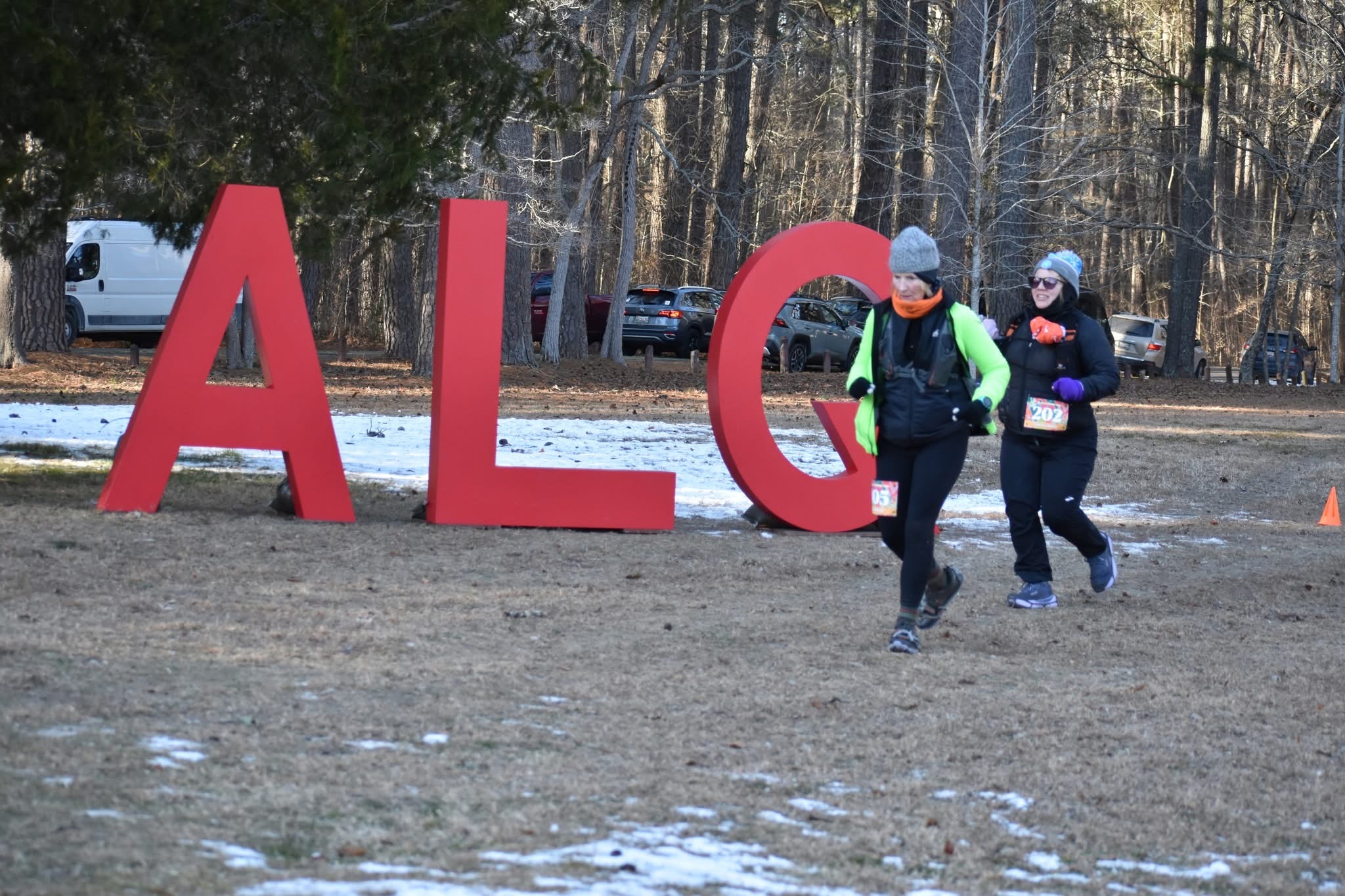
As soon as I started seeing the weather forecast for Saturday, Feb. 7, I started worrying. We’d had some much colder than usual temperatures here on Delmarva, and as race day for the Algonquin 50K got closer, the “feels like” temperatures were predicted to be in the negatives for basically the entire race — with the temperature getting colder after the start instead of warmer.
However, I’d signed up for the race, and I decided that I was going to at least start and see how it felt. If I ever felt like my health was in danger, then I’d stop. I have gone to the hospital for heat-related running issues, with both instances now being more than a decade ago, and I wanted to ensure I prioritized my health in the extreme cold. I don’t mind running in inclement weather, but I didn’t want it to actually be dangerous.
Initially, I wasn’t even planning on running the Algonquin 50K this year — I’ve volunteered each year I haven’t run the race —but after a summer group run, I was chatting with Nate, and he gave me the confidence I needed to just sign up. I’d also been hearing some things and did not want to miss the opportunity to run this year.
My training went well. I trained for and ran the Space Coast Marathon at the end of November, and although I didn’t run that as fast as I’d have liked on a warm day in Florida, I did get the mileage in. Then, between the marathon and Algonquin, I ran 270.59 miles.
I picked up my race packet at the Hampton Inn the evening before the race. Swag included a custom Algonquin seat cover, a designed and printed map, a magnet and the bib. I also bought a shirt, which had a Goatman alteration of the Algonquin logo on the front and the words “You get what you train for” on the back. I felt I’d trained for a good finish, though hearing there was snow and ice on the course wouldn’t help. I knew I would be close to the eight-hour cutoff even without snow and ice. However, I bought the shirt anyway.
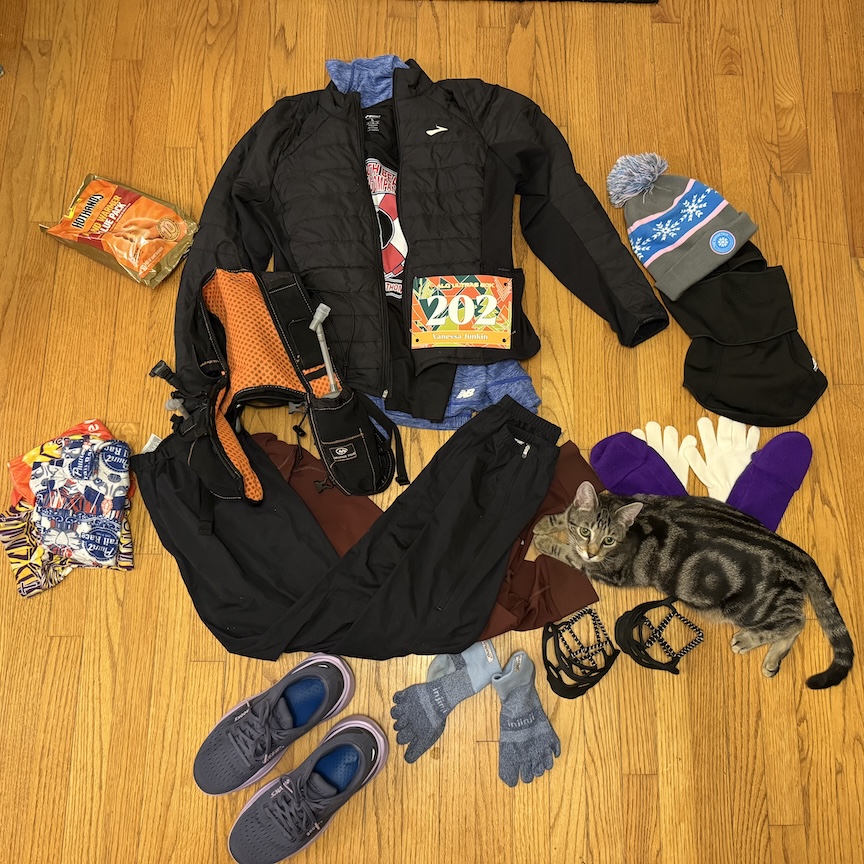
The night before the race, I laid out all my clothes and other items — the most I’ve worn for a run. Heavy winds were expected, which is what would make the predicted “feels like” temperature so much lower than the actual temperature — which started in the twenties and went into the teens.
I took a screen shot of the weather app on my phone after the race, at 4:02 p.m., and it said the actual temperature was 19 degrees and the “feels like” temperature was -7 degrees. I remember seeing a “feels like” temperature of 3 degrees before the start. These are rare conditions for our area. A post from Delmarva meteorologist Alex Seymore before the event said “Saturday will be one of the coldest days of the last 20 years.”
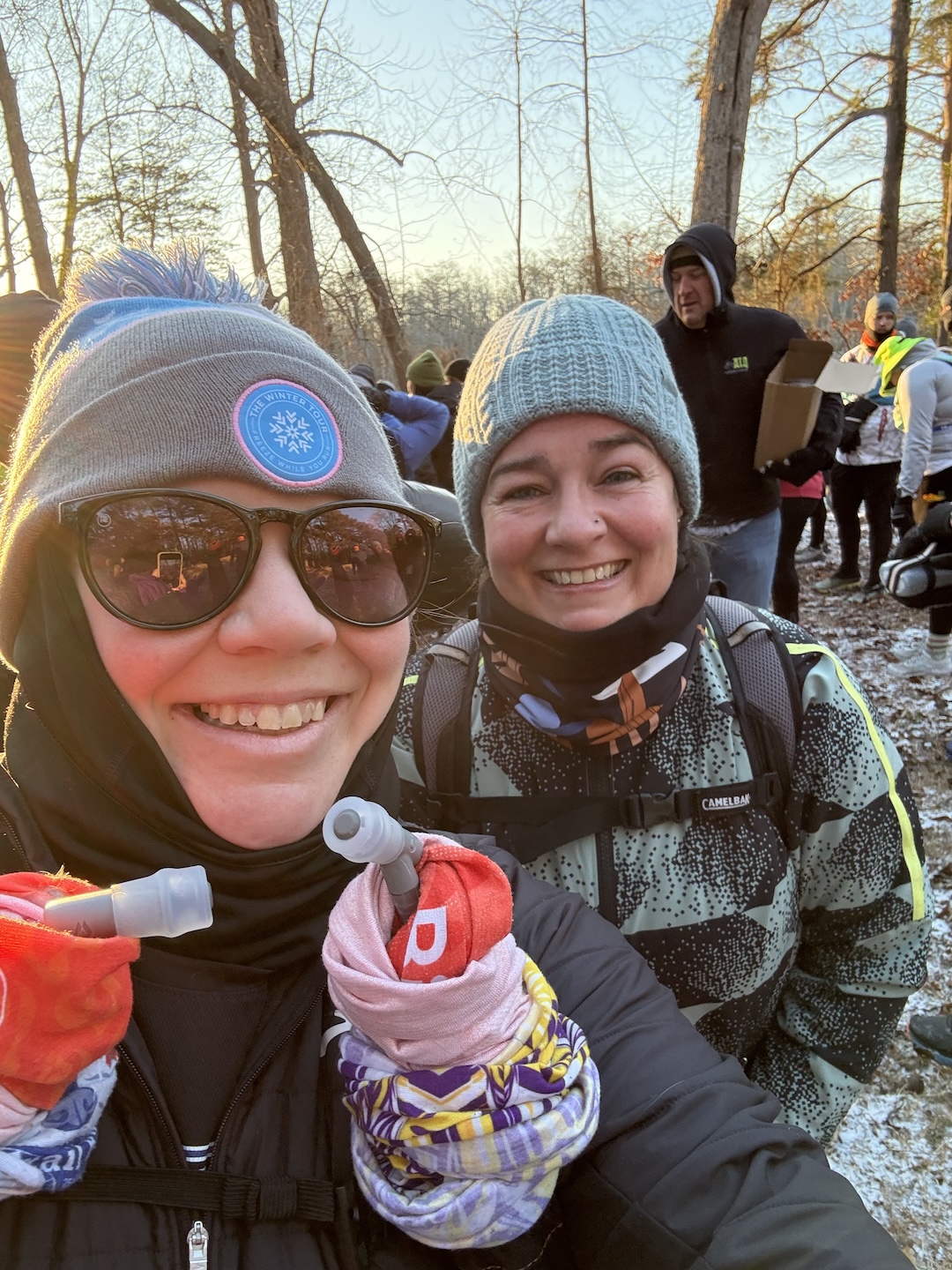
The race started at 7:30 a.m. I arrived to Pocomoke River State Park: Milburn Landing around 7 a.m. and was able to go to the bathroom. I saw Diana at the start and we chatted and got a photo before the race began.
A good start
My plan was to run the first four miles, since it’s more congested than the rest of the course, and then switch to run-walk intervals. I’ve done most of my training with run-walk intervals, and I always enjoy them, especially to help me break up and get through longer races. Once I switched to intervals, I did four-minute-run, one-minute-walk.
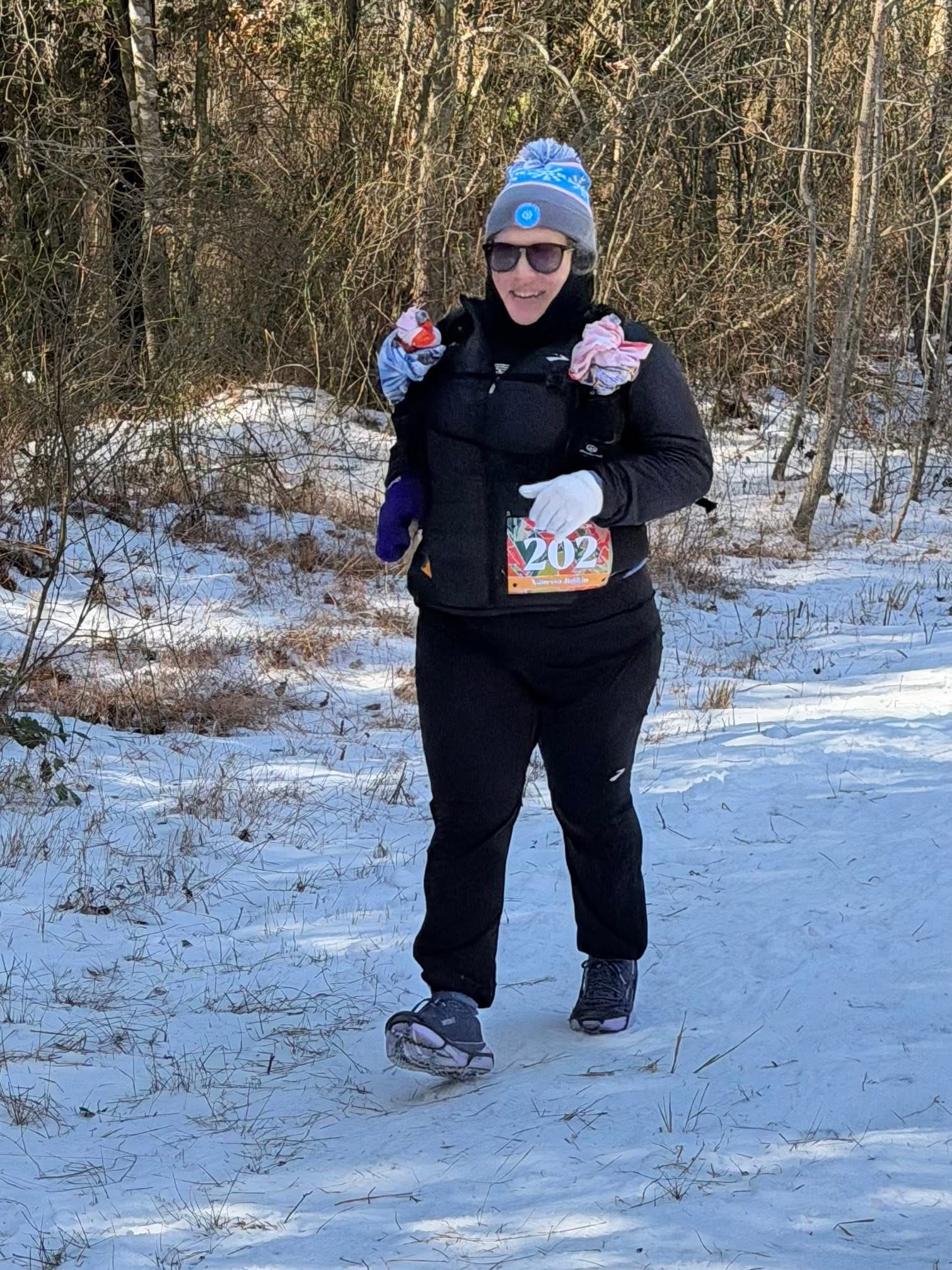
Early on, I had to pull over briefly to reattach the Yaktrax to one of my shoes. I’d trained in road shoes, and the first year I ran the Algonquin 50K, when I finished under the cutoff, I wore road shoes. I prefer my road shoes to trail shoes. However, with snow and some ice covering most of the course, I figured some sort of traction would be needed. Trent, the race “dictator,” had posted in the Algonquin Ultras Facebook group ahead of the event to recommend Yaktrax or spikes for the conditions on the course, so I bought Yaktrax.
Leading up to the race, the temperatures in our area had been much lower than usual, with a snowfall about two weeks before the race that was still hanging around. In the few days before the race, the temperatures were in the mid-30s, and that actually felt good compared to what we’d experienced.
This was my first run in Yaktrax — and it was about 32 miles — but I was glad I had them. I felt like the extra traction really helped. I got the Yaktrax back on my shoe, and then they were secure on both feet for the rest of the run.
I’d put together a playlist and listened to music along the way. I turned it off when I was near others, talking with others or at aid stations. Even though the playlist was only five hours and 43 minutes, I only had to restart it pretty close to the end of the race.
The first aid station was around mile four. I was happy to see friends there, but I kept going, knowing I wouldn’t have much time to spare. After those first four miles in the woods, surrounded by trees, we got a burst of wind when we headed onto a road near an open field right after the aid station. I was definitely feeling for the volunteers the entire time. I did not feel too bad most of the time while running, but I knew it could not feel good to be standing still — especially in the wind.
After a short time on this road, we turned onto Corner House Road, a dirt road. What can sometimes be a place to make up time had snow and probably ice on it, and it wasn’t extremely easy to run on. From Corner House Road, we turned onto a wider part of the trail. After we made the turn onto this part of the trail, one of the other runners, who introduced himself as Mike, asked if I was the blogger. He said he had read my the 2023 post I’d recently shared multiple times to prepare for the race, and that it had helped. That meant a lot to me!
The last time I ran the Algonquin 50K was in 2023. My time was 8:02:54 — less than three minutes over the eight-hour cutoff. So, of course, I had hoped to run the course in under eight hours this year.
For the first half of the race, I was pretty much on track to do that. I felt better than expected, and seven of my first 10 miles started with a “13,” with the others starting with a “14.” With a distance of about 32 miles, runners need to keep up a pace of sub-15:00 miles to finish in under eight hours.
Joe Andrews was out on the course taking photos, and he was able to get some great photos around mile nine or so. Around this time, I was running near Michelle, Janet and another Mike.
Not too long after I saw Joe, I made it to the Delmarva She Runs This Town aid station, around mile 10. It was great to see friends from DSRTT, and Elizabeth refilled my water bottle. I also had a small piece of Smith Island Cake and some potatoes. I’d been hoping to stop at a porta-potty here, but there wasn’t one at this aid station, so I waited until the next one.
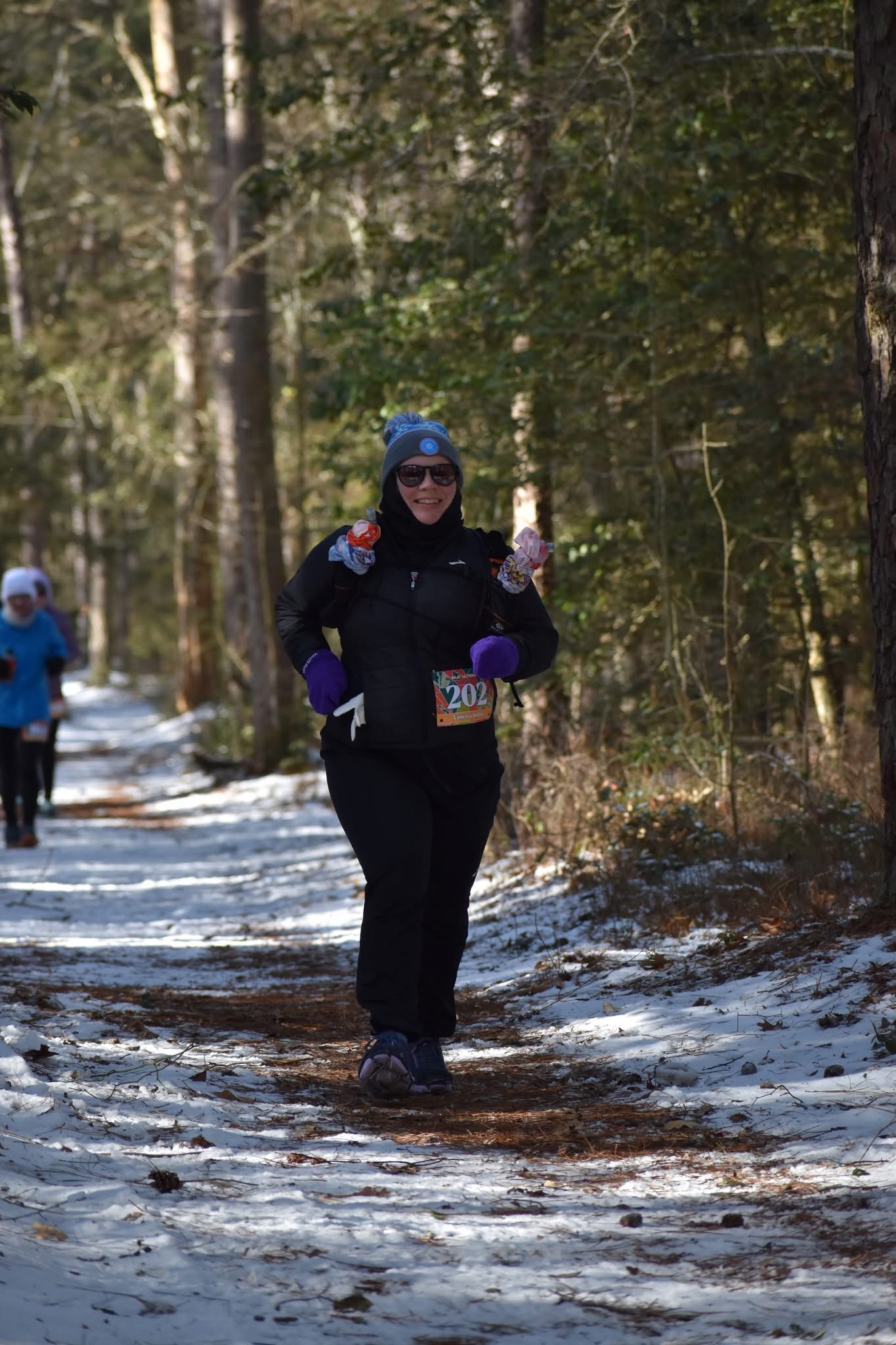
Including the aid station stop, mile 11 was my first mile over 15:00, at 15:40. Janet started running with me during this section, and we were also near Lisa. After we left that aid station, we had a stretch on the road before turning into the sandy area. I thought it might not be sandy because of the snow, but it was still somehow sandy. For a mile or two, the course was also colder and windier, as it was a more open area. I was looking forward to getting back into the woods and having more trees to block the wind.
Leading up to the race, I did three training runs out on the trail, and during one of the runs, I’d done this loop twice for a total of 21 miles. So, I was familiar with the course and knew what to expect.
We had until 11:20 a.m. to make it to the mile 15 aid station, which on my watch was slightly after mile 15. I started texting my fiancé, Mike (different than the previously mentioned Mikes), after I made it through each aid station and how far ahead of the cutoff I was.
About halfway
I had my water bottle refilled at the aid station and also got some broth. Tara offered to help, but two people were already helping me, so I was covered here. Again, all the volunteers were great and truly deserve a lot of credit for their excellent service in frigid conditions. I continued along to the porta-potty that was slightly after the aid station and went to the bathroom before an out-and-back section. Runners would be back at the same aid station again around mile 19.
I had a list of all the aid station cutoff times in my phone, and there was also a yard sign on the course a mile before each cutoff with the cutoff time listed. At each sign, I looked at my watch to see how long I had to run the next mile.
When I texted Mike that I had passed the mile 15 aid station, I was already past the aid station and was 10 minutes ahead of the cutoff time. I got to see some friends on the out-and-back section, and sometimes I would go back-and-forth with nearby runners, but I was really on my own for the second half of the race. Michelle and Myron were at the turnaround, and after turning around, I was heading toward the mile 19 aid station.
I made it through that aid station 15 minutes early and had some more broth and got another water bottle refill there.
The Midshore Multisport aid station is the toughest cutoff other than the finish, in my opinion. In 2022, I was cut at this aid station. There are more miles between the mile 19 aid station and the Midshore station, which is around mile 24.5, than there are between Midshore and ESRC, a little before 28.5. I figured if I made it to the Midshore aid station, I could make it to the finish, even if I had an unofficial time.
Because of the less-than-ideal weather conditions and telling myself before the race that I could stop if I needed to, I felt like I had taken the pressure off myself. I mostly focused on making it to the next aid station in time. Of course, I’d have liked to have finished under 8:00, but I could feel my pace slipping. I had to make a bathroom stop in the woods after mile 19, too.
Around mile 21.5, I switched to two-minute-run, 30-second-walk intervals. This was the same ratio as before, just more frequent changes. I’d done this on a training run with Mark Cotter, and while I didn’t want to interrupt my music as often, I did enjoy these intervals, and they kept me motivated.
When I got near the Midshore aid station, I saw one of the volunteers, Mark Doyle, in a bright orange outfit. He’d been looking for me at the aid station and came to run me in. Again, I had my water refilled, and I also had some broth, potatoes and chips. I love sweets, but during the race, I was looking for more salty foods.
When I left the Midshore aid station, I was six minutes ahead of the cutoff. I walked for a little bit as I finished eating the aid station food I had with me, stuffing the cup in my pack. For a while, I was able to drink out of at least one of my bottles (I had two soft flasks with tubes), but by this point, both tubes were frozen, so I had to unscrew the cap to drink out of the bottle.
Running can be very mental, and at this point, I knew I’d made it through what I considered to be the toughest aid station cutoff. I was walking when I needed to, and I started walking more in this section. However, as I got closer to the ESRC aid station, I did make myself run some more, as I certainly didn’t want to get cut less than four miles from the finish and at the ESRC station, where I have volunteered each year I haven’t run.
I did notice that it seemed like I might not be getting enough air, probably because it was so cold, and I also found myself making some odd exhausted sounds, particularly in the last 10 or so miles. However, I just walked as needed and I never felt in danger or unsafe, just tired.
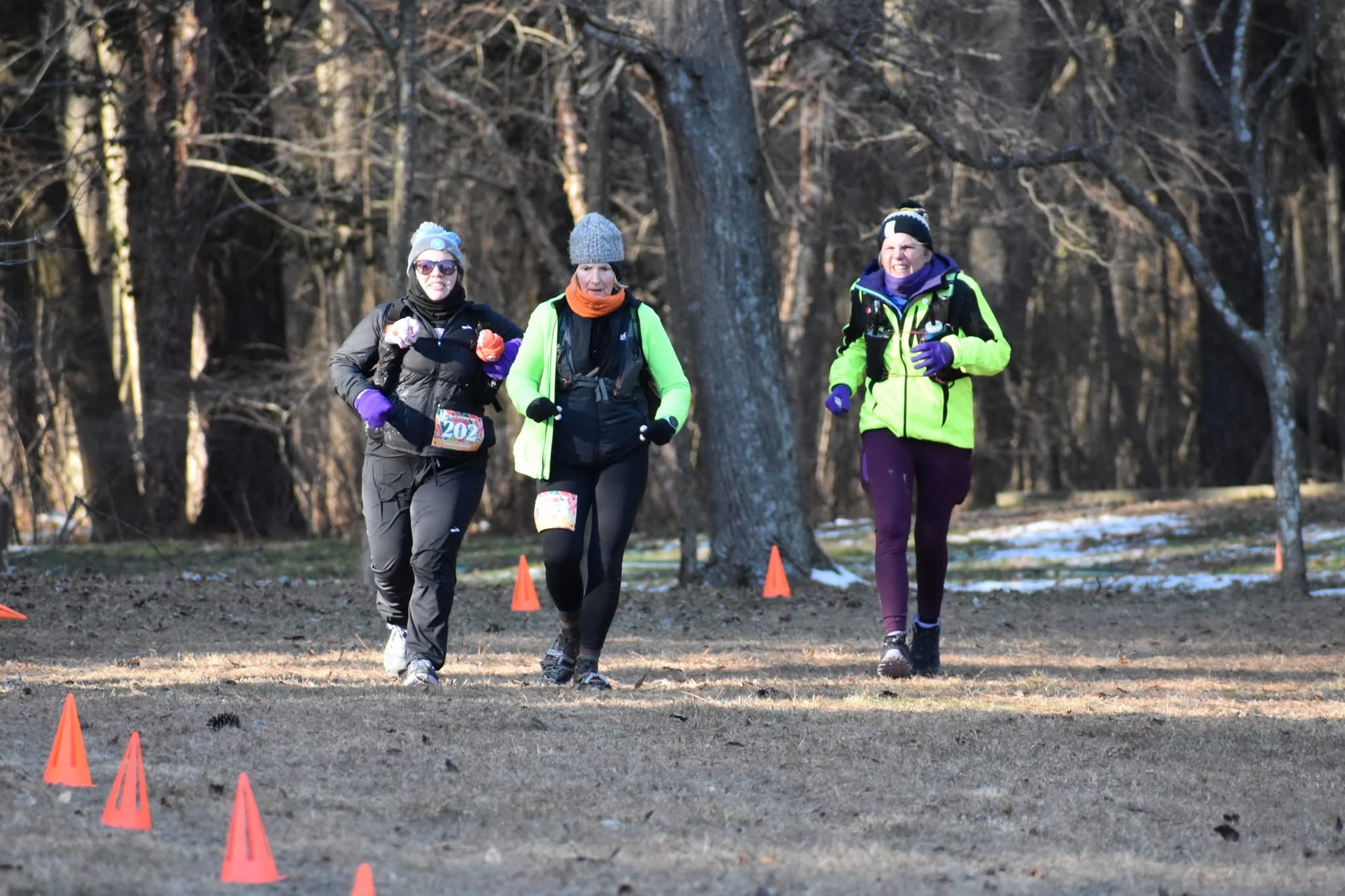
The last miles
I saw friends at the ESRC aid station, had my bottle refilled again and got some more broth. I’d also had some of my Clif Shot Bloks throughout the race, but I probably did not eat enough.
I left the ESRC station five minutes ahead of the cutoff. This meant I had 50 minutes to make it to the end by 3:30 p.m., the cutoff time. I really felt like I needed at least an hour from this aid station to make it to the end. If I felt like I would have been close, maybe I would have been able to push a little harder, but I’m really not sure.
I did not feel overly cold, but I do think the cold was draining my energy, something I also experienced at the 2024 NCR Marathon. I figured it was unlikely that I would run 3.5-plus miles in 50 minutes after running close to 28.5 miles in freezing temperatures, but I tried to keep up the run-walk intervals, with some extra walking built in. There were a handful of runners that were not close but kind of near each other at this point; sometimes I’d see brightly-colored running jackets in the distance. Penny had passed me between the Midshore and ESRC aid stations, and it was great to see her.
Until this last stretch of the race, I was primarily completing my miles in 15:00-something or less, except for the aid station miles, which took about 19 or 20 minutes. My last few miles did get slower — 17:42, 17:19 and 18:14, with the last mile “speeding up” to 15:43.
I neared the finish line and had caught up with two other runners, Patti and Mary (I don’t think I’ve met Mary, but I saw her name on her bib). The inflatable finish line arch was not up, and at first I thought it was because I was after eight hours; then, I realized it must not have been up because of the wind.
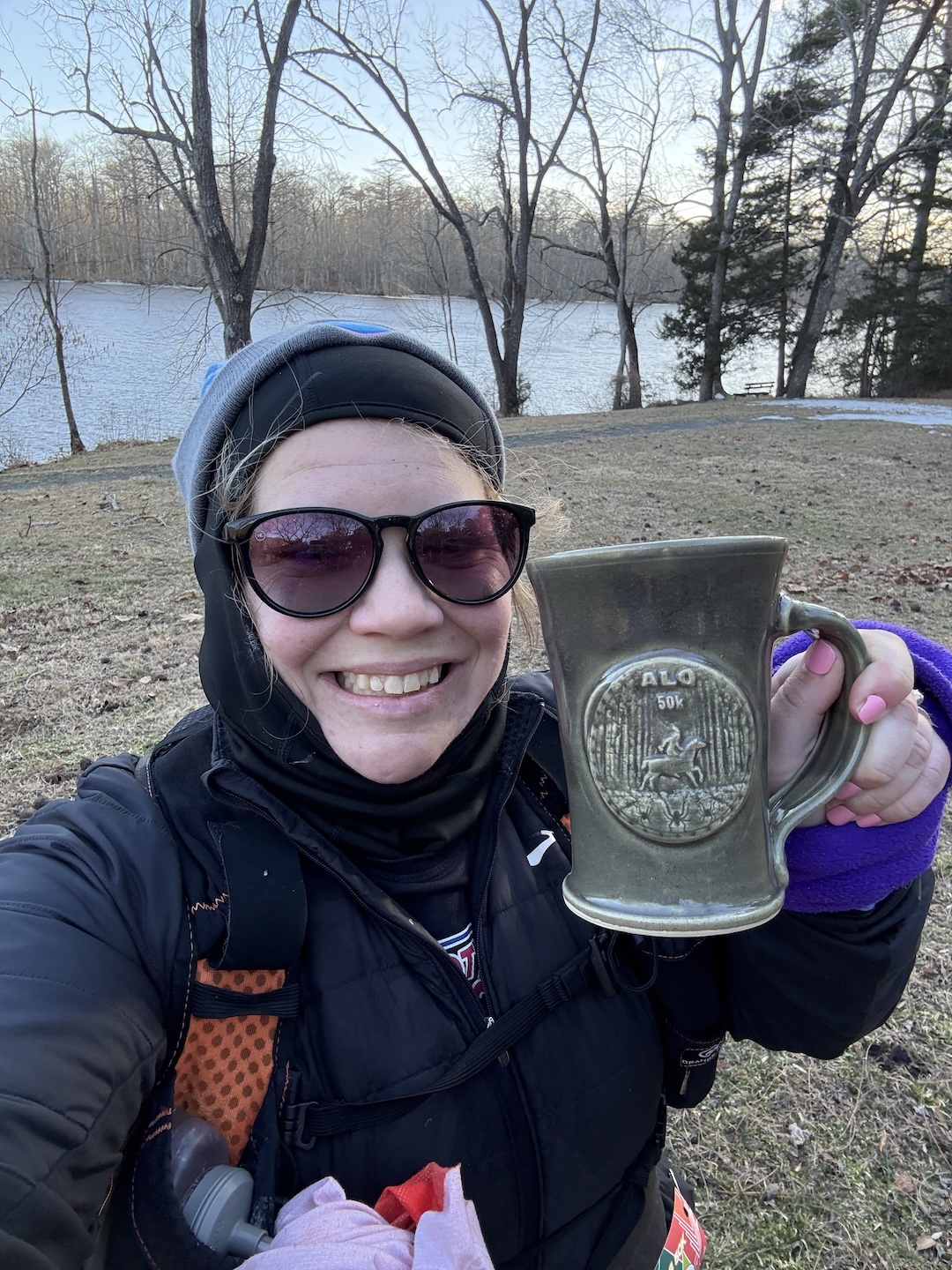
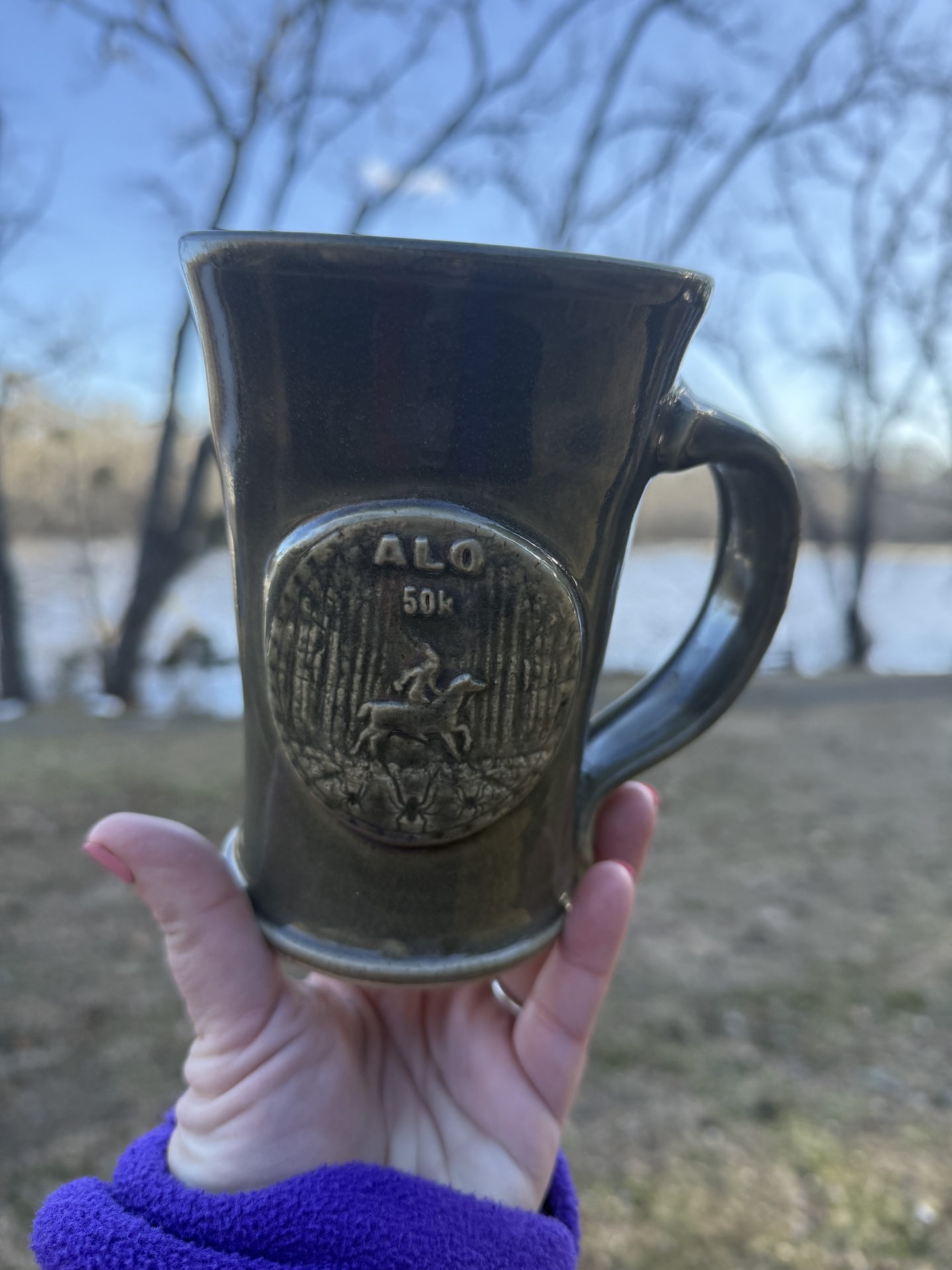
Trent greeted us at the end, and I received an beautiful green mug — not smashed — from him! I did see the remains of some other mugs; mugs are smashed for those who don’t finish the race.
I went into the pavilion, where there was a fire and heaters, but I just felt exhausted. Most of the food was gone; I did get a potato and some beer (the beer was unopened and I had it later). I sat down for a short time and started freezing up. I had felt fine enough while running, but I was starting to feel miserable, almost crying when I talked to Mike on the phone as I walked back to my car.
I didn’t spend much time at the after-party, wanting to get to some warmth. Once I got back to Salisbury, I picked up a latte and a barbecue sandwich before heading home. The Smith Island cake had also run out by the time I finished, so I bought a piece a few days later.
My time on my watch was 8:12:46 — 32.09 miles in a 15:21 average pace. Of course, it doesn’t matter, but I did notice that I hit 50K on my watch just before eight hours, around 7:58. I knew to expect more than 31.1 miles — when I ran the course in 2023, I logged 32.08 miles. The out-and-back section between miles 15 and 19 was different this year, but the distance stayed the same.
My time on the results was 8:11:10, but the start and finish were at slightly different locations, so I think this cut about a minute of running off. I’m thinking 8:12 and change is more accurate.
It was quite a journey. I think given my current level of speed, my time in these conditions is not bad. When I ran a time of 7:48:46 the first year of the Algonquin 50K at age 26, I’d run a marathon in 4:53 the prior month. This year, at age 35, I ran a time of 8:12:46, but I ran a recent marathon in 6:07. (I do think I could have run a faster marathon if it wasn’t so hot, but even a good day for me at this time would be sub-5:30). I had originally wanted to wait till I improved my marathon time to try again at the 50K. So, we’ll see what happens in the future.
Thanks again to Trent and the Algonquin Ultras team, all of the volunteers and everyone else who is a part of this race for making it the special event that it is.
Splits
Mile 1: 13:14
Mile 2: 13:12
Mile 3: 13:37
Mile 4: 13:12
Mile 5: 14:51
Mile 6: 14:20
Mile 7: 13:43
Mile 8: 13:32
Mile 9: 14:04
Mile 10: 13:55
Mile 11: 15:40
Mile 12: 14:24
Mile 13: 15:08
Mile 14: 14:35
Mile 15: 14:40
Mile 16: 20:27
Mile 17: 13:59
Mile 18: 14:31
Mile 19: 14:03
Mile 20: 20:40
Mile 21: 14:55
Mile 22: 14:55
Mile 23: 14:51
Mile 24: 15:31
Mile 25: 19:14
Mile 26: 16:59
Mile 27: 15:21
Mile 28: 15:01
Mile 29: 17:42
Mile 30: 17:19
Mile 31: 18:14
Mile 32: 15:43
Last bit (.09): 0:58 (10:45 pace)
Final time on watch: 8:12:46 for 32.09 miles; 15:21/mile pace
 She Runs by the Seashore