
I hadn’t even reached four miles at the REVEL White Mountains Marathon, and I noticed soreness in my quads as I ran downhill along the Kancamagus Highway in New Hampshire. I’ve always liked downhill portions at races, but such a steep, extended downhill was new to me.
I did train for this marathon — not my best training cycle ever, but I made sure to get some long runs in and continued the rest of my regular running. However, I live in a super flat area, and I didn’t train for the course. I’d read that downhill-specific training is important, but I didn’t really do much different with training than I’d done for other marathons, aside from going on the stair climber a bit. Spoiler alert — I did finish the marathon; I just felt soreness earlier than I would have on a flat course.
My race weekend started the Friday before the race, May 3, when I made the drive from Salisbury, Maryland, to North Conway, New Hampshire. I left early, and with the stops I made, it took about 12 hours. I went straight to meet up with my friend Jess for dinner, and then I went to my Airbnb, located on a mountain and only a few miles after a “Bear Crossing” sign (I didn’t see any bears). My Airbnb host, Peg (who regularly sees bears and other wildlife), would be running the half marathon at the race, and we talked for a while about running.

On Saturday, I got my race packet at the Ham Arena — the expo was set up at an ice rink without the ice — and then Jess and I drove about an hour to ride the Mount Washington Cog Railway. We rode the train up the steep incline and then had about half-an-hour to walk around at the summit of Mount Washington, located at 6,288 feet, before heading back down. I visited the White Mountains one other time, but I didn’t get a chance to see Mount Washington. Jess had been many times and knew all the fun facts!
Everywhere I went, there were runners who were in town for the race. Jess and I saw runners on the cog railway, at the Omni Mount Washington Hotel, where we made a brief stop, and even when we stopped to see a waterfall on the side of the road. Later in the trip, I chatted with runners at Tuckerman Brewing Company, Sweet Maple Cafe and when I stopped to take photos at scenic vistas on my way home. Before the race, Jess and I met up with Peg and a runner Peg met at the expo, Bill, for dinner.
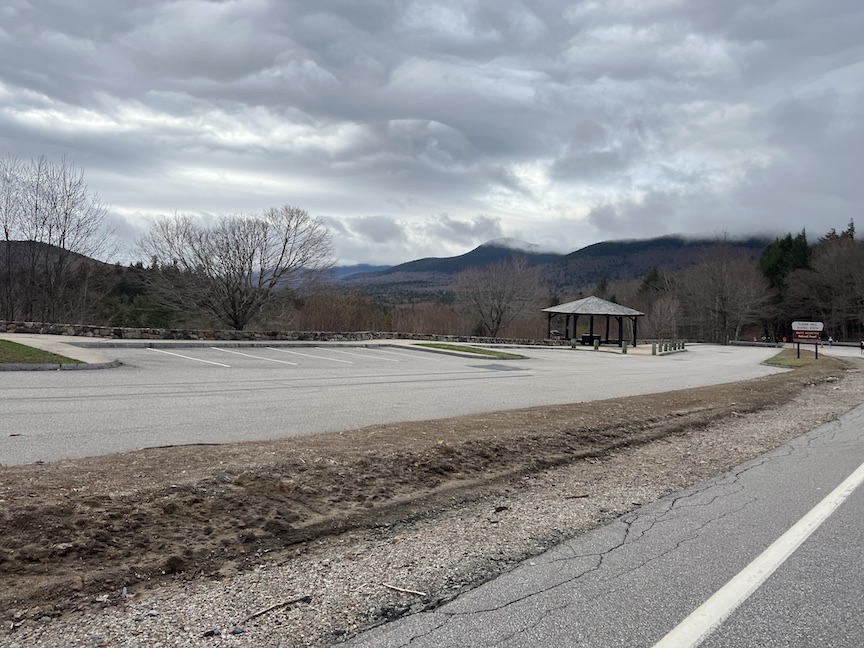
Race morning started early Sunday, May 5. Bus loading for the marathon was set to take place between 3:15-4:15 a.m., and I was staying about 15 minutes away from the parking area. My first alarm was set for 2:50, and I planned to get to the start area somewhere in the middle of those times. I was on the bus at about 4 a.m.
The race started at 6 a.m., which is the earliest I can recall starting a race. I had oatmeal that morning and also brought a stroopwafel with me. We had about an hour ride to the start, which was at the CL Graham Wangan Overlook. I’m not usually too worried about getting cold before a race, because I run really warm and don’t get cold easily when it comes to running and races. However, as we were heading to a much higher elevation on a mountain, I wore a hoodie and joggers, along with the mylar blanket and gloves we had been given, and I was glad I did. It was cold and foggy at the top. The marathon course has a 2,350-foot elevation loss, with about 1,400 of that in the first five miles.
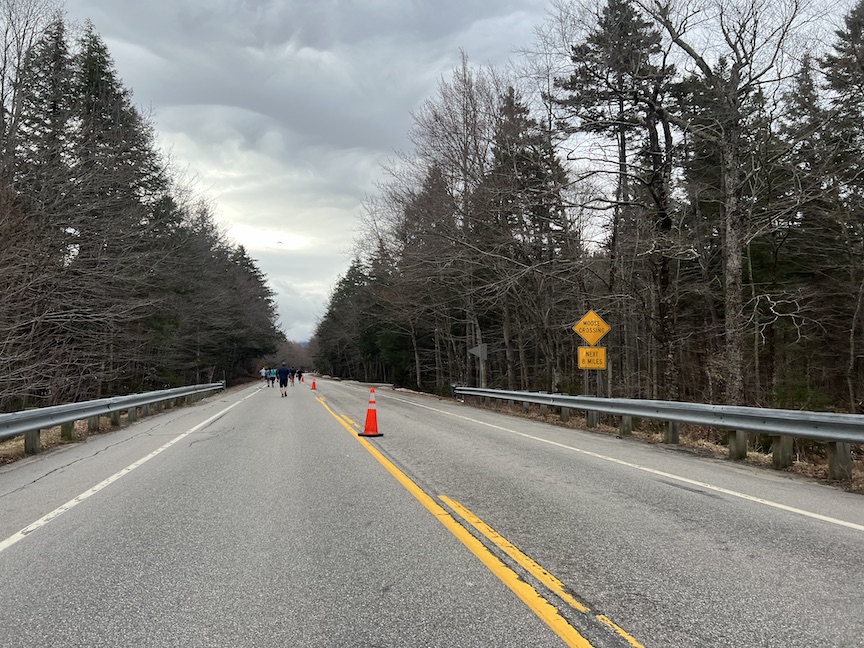
When I got off the bus, I found the end of a line for a porta-potty and waited in it. I was in the line for about an hour, reaching the end right before the race began. During the wait in the line, I brought my drop bag to the truck that would bring them to the finish, along with the bags of two other runners.
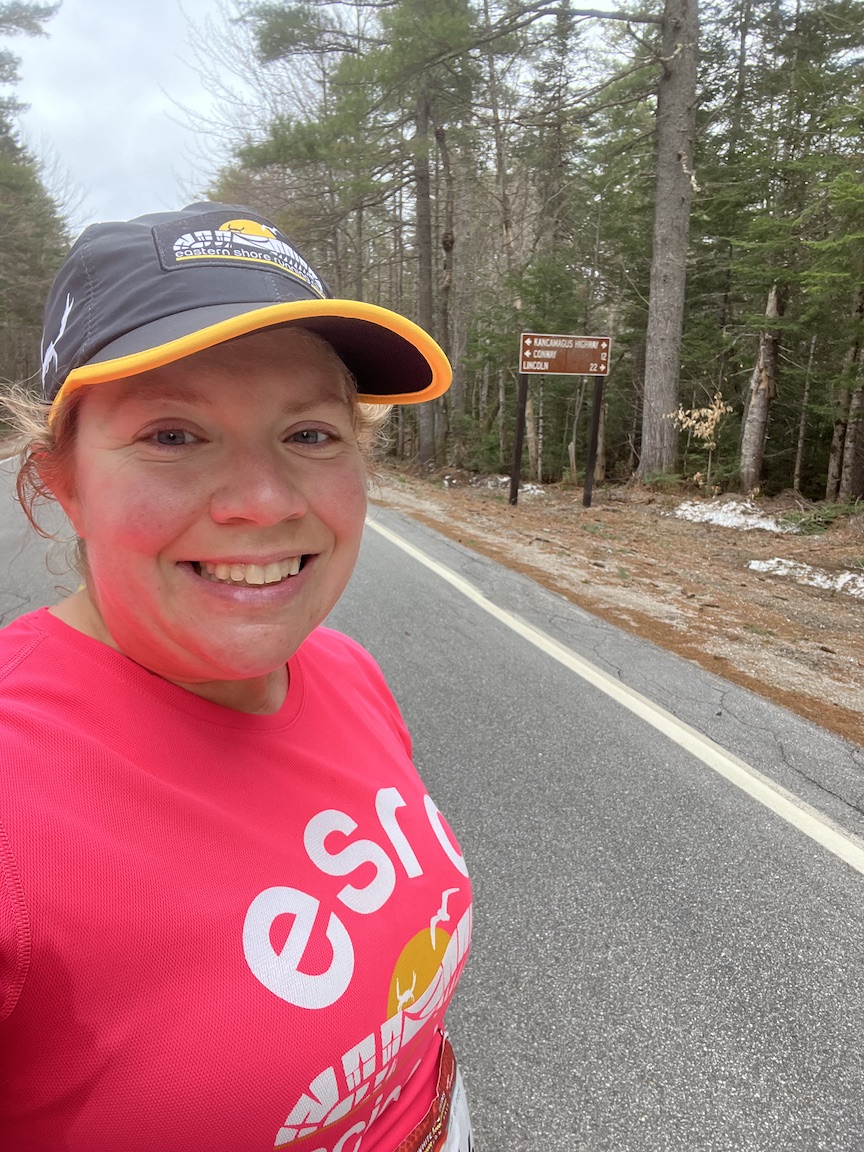
The first five miles of the race had a steep decline, and there were signs warning trucks of the 7 percent downhill grade. I didn’t want to run too fast or hold back too much, and I thought I kept it somewhat reasonable by running 10:24 and 10:48 for the first two miles. I expected my pace for the entire race to average somewhere in the 12s, but I was not sprinting to run those paces in the 10s. Sometime before I hit Mile Marker 4, I was feeling my quads, and my next few miles were not slow, but a bit slower, at 11:08, 12:32 and 11:58.
In these first few miles, I saw snow on the side of the road, the Sugar Hill Scenic Vista and a “Moose Crossing” sign. I didn’t see any moose, but someone on the bus ride back after the race did.
This was my 17th marathon, and I still haven’t been able to get through one without having to make a bathroom stop. I ended up stopping at two consecutive aid stations to go to the bathroom, during Miles 6 and 7. Luckily, there was little wait at the first one and no wait at the second, as there were plenty of porta-potties, but it was still not ideal to have to stop. However, I would be running for a long time, and it was worth making the stops to feel comfortable.
After my first bathroom stop, I noticed I’d been passed by the 5:30 pacer. I nearly caught back up, but after the second stop, I wouldn’t catch up again.
I was keeping up a pretty steady pace, aside from the bathroom stops, and then came an out-and-back of about four miles total. The “out” of the out-and-back was a steep uphill, which may have felt even worse than a normal uphill because of all the downhill running preceding it. I walked most of the way up, which meant that of course, my pace was slipping, and I was getting further away from the 5:30 pacer. I completed Miles 11 and 12 in 15:16 and 14:05. I had hoped to run my fastest marathon since 2019, which would mean beating the time of 5:29:15 that I ran in 2020 at the Publix Atlanta Marathon (I ran 4:50 in 2019, and I knew I wasn’t going to get there).
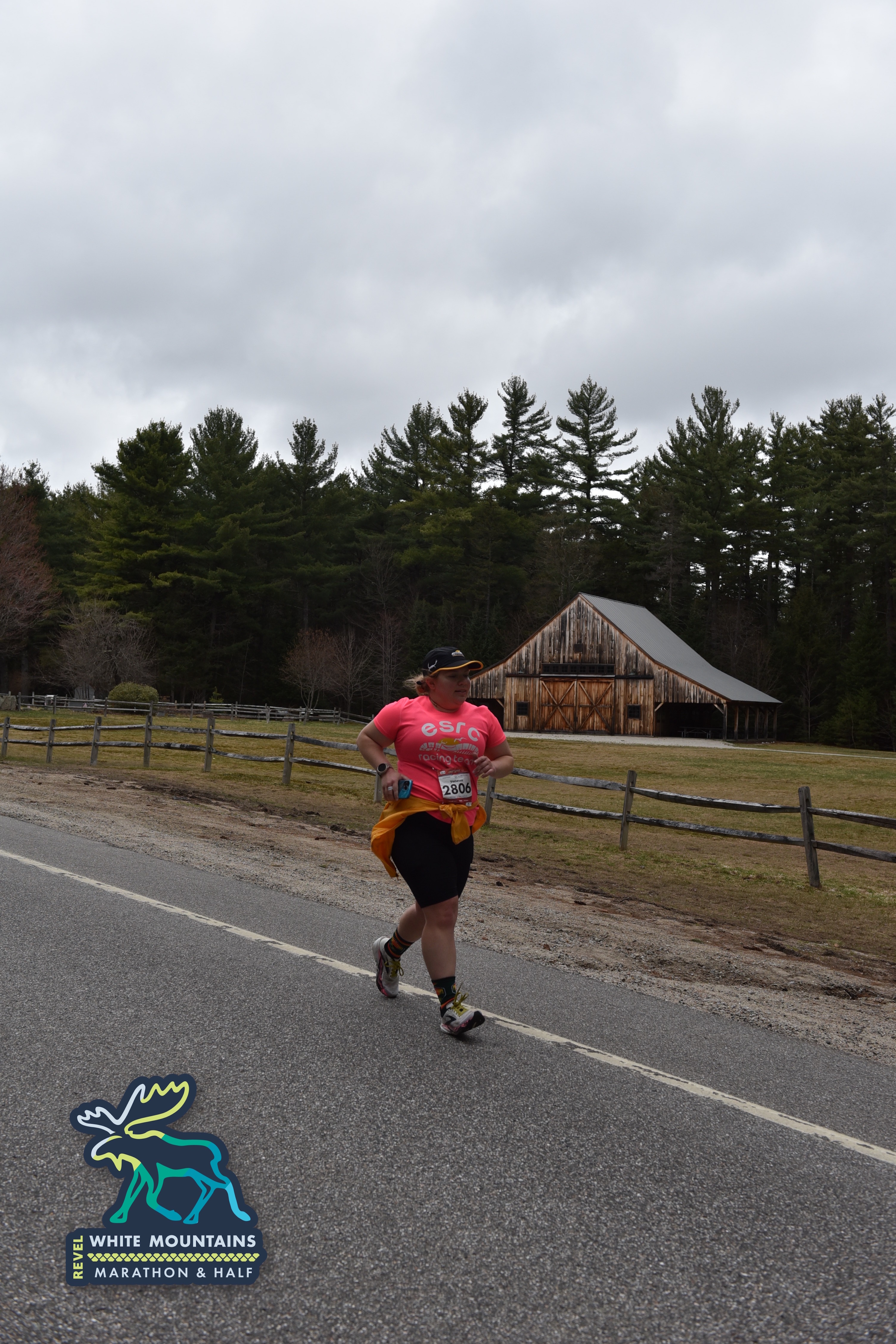
As I struggled up the hill, there were plenty of happy runners cheering us on from the other side. It was nice to have the support of other runners, including Jess, who I saw soon after I started the out-and-back. I was also able to see the 5:30 pacer once I got closer to the turnaround, and figured I may be about 0.4-mile behind him. I looked at my watch at the halfway point, and I was at 2:48-something. I wondered if maybe I could catch back up to the 5:30 pacer, especially since I’d taken the two bathroom stops, but I figured it would be unlikely for me to negative-split a marathon, especially when I was feeling the earlier miles. There were a few, but not many people going the other direction as I headed down the hill. I finished 1,618 of 1,683 in the marathon — only ahead of 65.
Particularly in the second half of the race, I was around a lot of the same people as we did different run-walk intervals or were at slightly different paces. Around Mile 14.5, I decided to set up run-walk intervals (four-minute run, one-minute walk) on my phone. I’d walked as needed, but I needed something to keep me motivated. The rest of the course was basically a rolling downhill, so if I had a particularly good downhill, I would run through the walk portion, and I was also walking at each water stop.
I do run-walk intervals often in my runs at home, but because of the downhill running, there was a different feeling when I restarted running after each walk break. It even felt weird to start the walk. I was also having some issues with coughing, something that plagued me a couple years ago but has mostly improved once I found out what it was (irritable larynx syndrome).
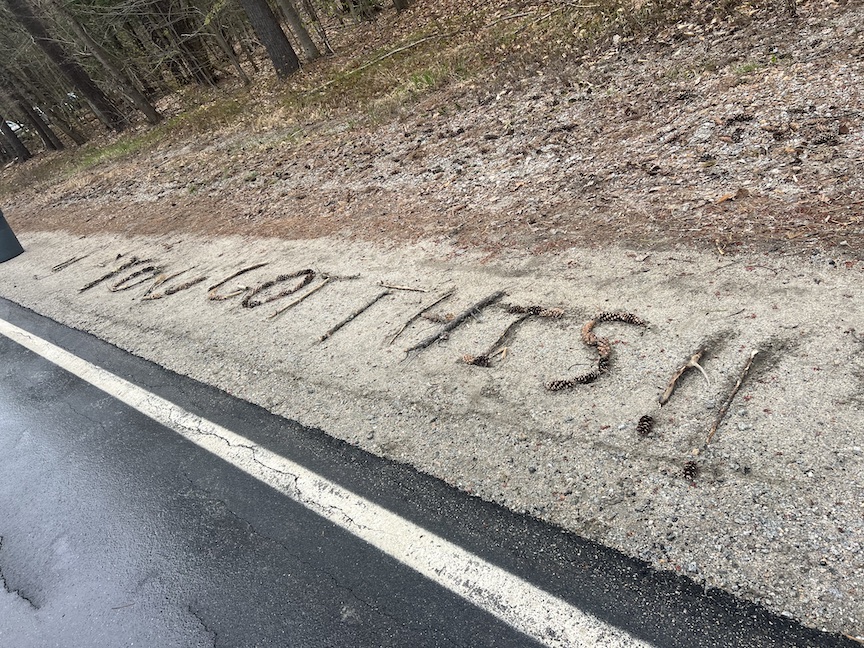
Along the way, I had a brief exchange with a board member of the 50 States Marathon Club, and right around that time, I mentioned I was from Maryland and someone said she’d just run my state a few weeks ago. “Salisbury?” I asked. She said yes, and that’s my adopted hometown race — I only live about a half-mile from the start and ran the half marathon this year.
For the last eight or 10 miles of my race, there was a light rain, but it wasn’t bothersome. I had started off with a light jacket but tied it around my waist pretty early on. I thought about putting it back on, but I didn’t need to; short-sleeves and shorts were fine. I was also going back and forth about which shoes to wear ahead of the race, and I was happy with the Brooks Hyperion Max that I chose.
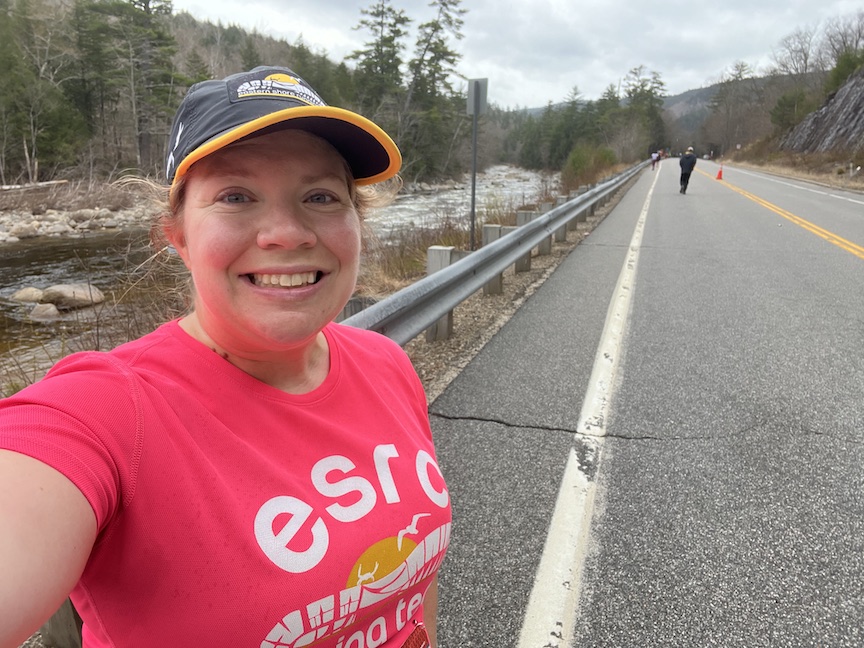
The Kancamagus Highway was a scenic place to run, and I enjoyed seeing the Swift River alongside the trees. There were also some small waterfalls off to the right and at least one larger one that was part of the Swift River, which was to the left. There were also plenty of mountain views.
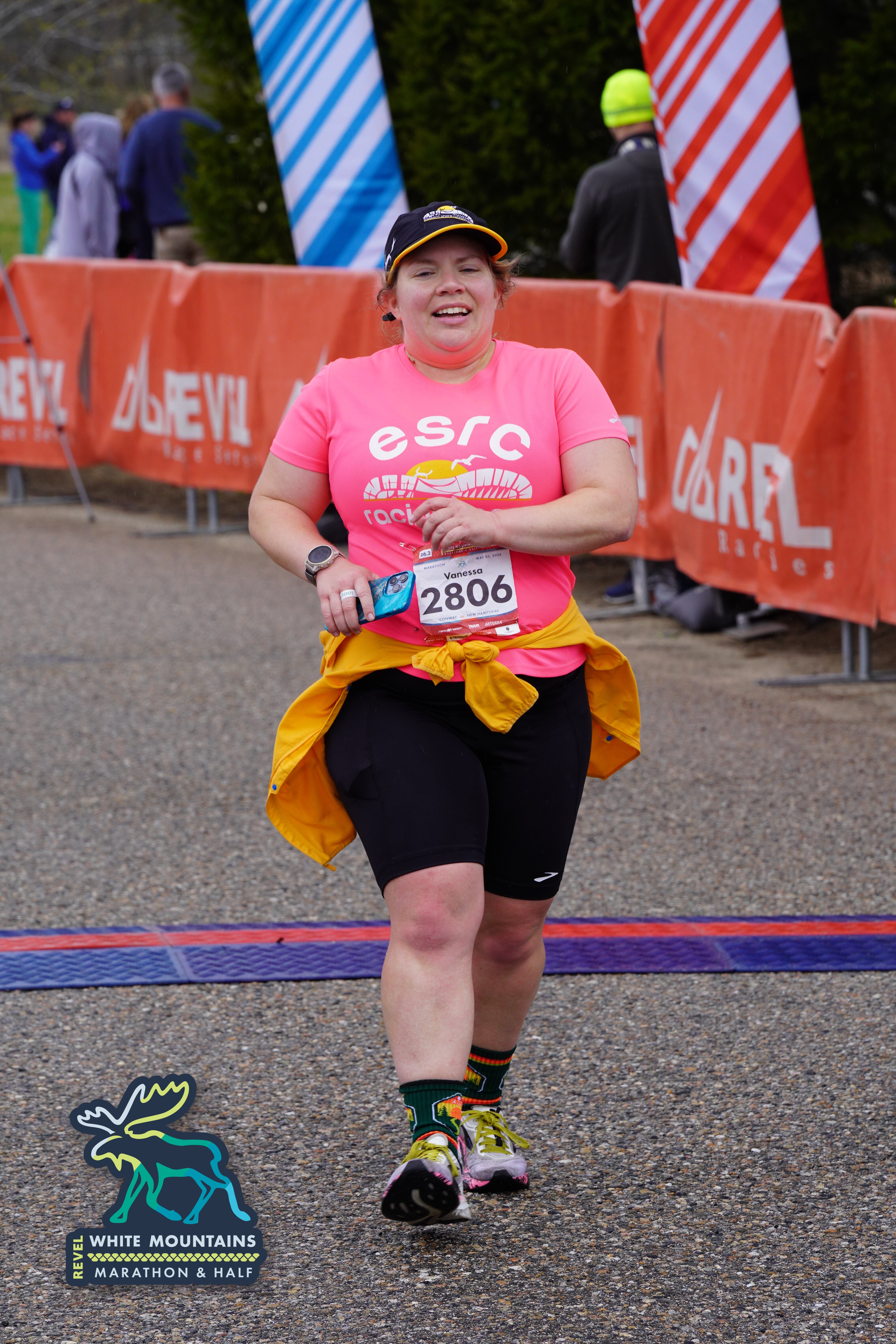
There were water stops about every two miles, and there were only a small handful of spectators other than volunteers — I think about three groups (one of which was one person) — until we got very close to the finish.
In addition to the steep downhill and rolling downhill portions, the road also had a steep camber, which was an interesting challenge. Peg had mentioned the roads were like this for draining snow.
Toward the end of the race, I tried to keep up the pace and figured maybe I could try to come in under 5:45. My last four full miles were consistent, with only a 16-second span from the fastest of those (13:32) to the slowest (13:48). I was pretty sure that even if I didn’t do that, I would at least beat my most recent marathon time, which was 5:53:58 at the Providence Marathon in 2023. Also, while my quads were sore and the coughing was annoying, I didn’t feel miserable like I did in the heat at Providence.
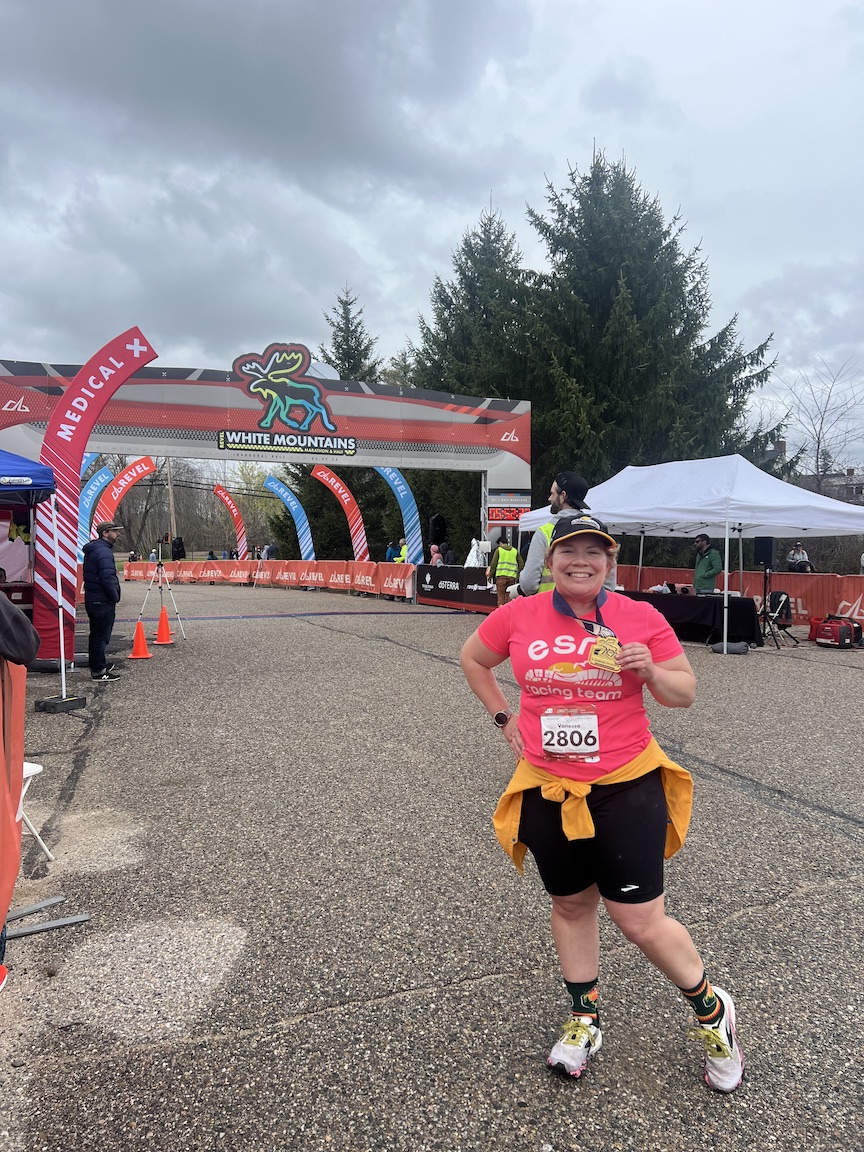
I didn’t stop too long for photos on the course, but I did make a few brief photo stops and took a few others while I kept moving. Most of them were of scenery or of me with scenery, but toward the end, I took a quick photo of sticks that had been set up on the ground to spell out “YOU GOT THIS!!” at one of the late aid stations. I knew it may stop me from hitting a certain time, but I didn’t think it would have a major impact, and it didn’t.
With about a half-mile left to go, and after a slight incline, we turned left at the end of the Kancamagus Highway onto Route 113/Main Street in Conway and then made a right turn toward the finish. There was a cheering crowd around Mile 26, now that we were in town and by the finish line. Someone in that group commented on my smile, as often happens during races, but I was excited to be almost to the finish line and also to see people.
Being close to the end gave me some extra energy, and I ran the last bit in an 11:17 pace. My watch had 26.31 miles, which is just about the closest I’ve gotten to 26.2 on my watch that I can recall.
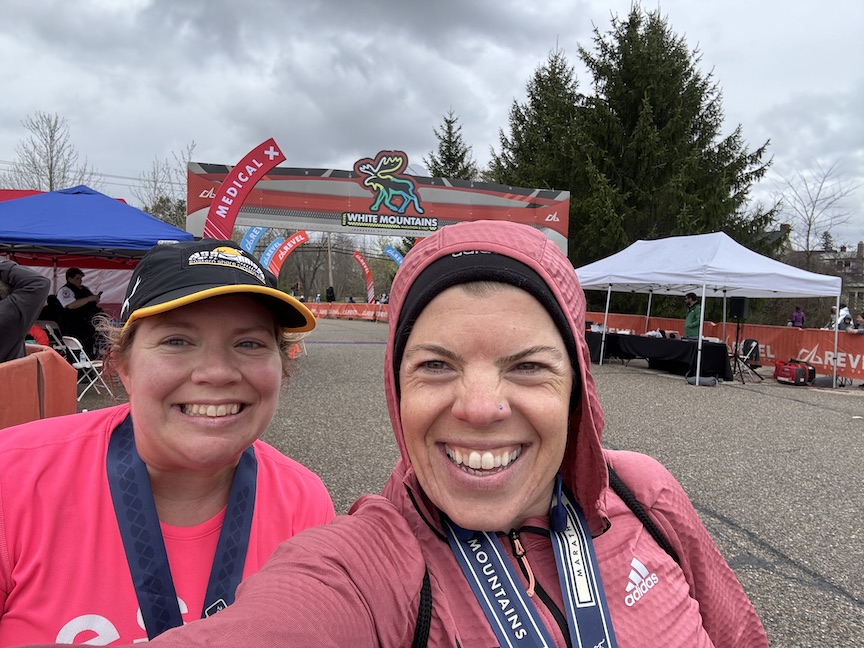
After crossing the finish line, I saw Jess almost right away. I got my drop bag and received a small bag of snacks, ate a Dunkin’ Donuts doughnut and got my beer from Tuckerman Brewing Company. I sat down in a folding chair and realized I was not able to straighten my legs fully. My legs used some muscles they never use!
I was hoping for a bit faster time, but I certainly learned what it’s like to run downhill and I also enjoyed the scenery and the experience. The race was well-organized and fun, and I enjoyed staying with and chatting with Peg, hanging out with Jess and exploring the area.
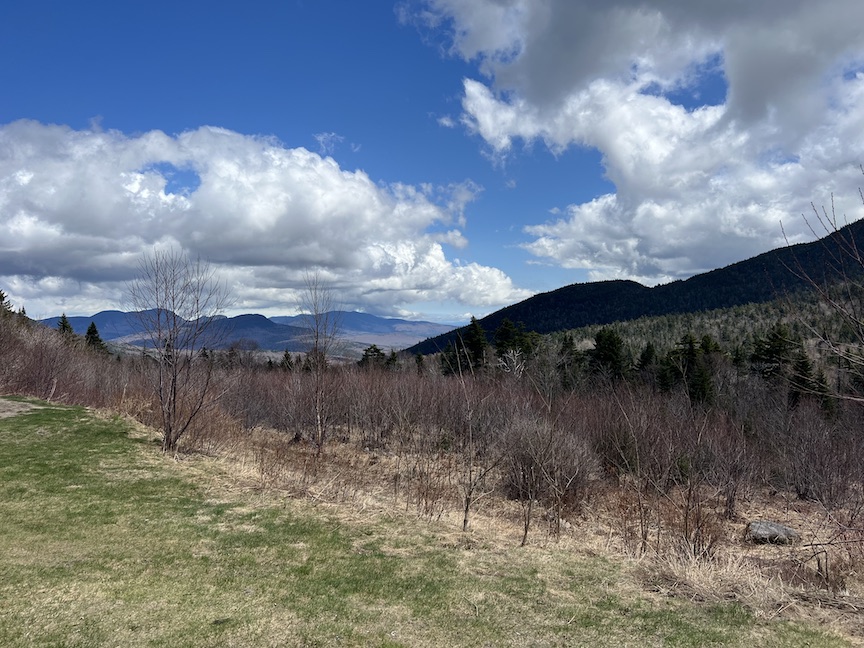
On my way home, I took a little bit of a long way and drove the Kancamagus Highway the other direction, stopping at some of the overlooks. I was treated to some great views and was able to see what the start area looked like, since it had been too foggy the morning of the race to see much there. I had been disappointed to see trash left along the scenic highway as I ran, but the next day, when I drove it the opposite direction, it was clean and looked as if there hadn’t even been a race the previous day.
New Hampshire was my 13th marathon state, so I’ve now run in a quarter of the states. I’m taking this journey slowly, and enjoying the experience so far. This was supposed to be the only year of this race, but the website makes it look like it could happen again, so stay tuned! Visit the race website here.

Splits
Mile 1: 10:24
Mile 2: 10:48
Mile 3: 11:08
Mile 4: 12:32
Mile 5: 11:58
Mile 6: 16:06 (bathroom stop)
Mile 7: 15:11 (bathroom stop)
Mile 8: 12:06
Mile 9: 12:50
Mile 10: 12:35
Mile 11: 15:16
Mile 12: 14:05
Mile 13: 12:04
Mile 14: 13:52
Mile 15: 13:20
Mile 16: 13:25
Mile 17: 12:53
Mile 18: 13:49
Mile 19: 13:11
Mile 20: 13:23
Mile 21: 15:05
Mile 22: 12:51
Mile 23: 13:38
Mile 24: 13:48
Mile 25: 13:46
Mile 26: 13:32
Last part (watch had .31): 3:31 (11:17 pace)
Final on watch: 5:47:18, 13:12/mile pace; final on results: 5:47:15, 13:15/mile pace
 She Runs by the Seashore
Great recap! I am still curious to try a downhill race. I do believe they’re harder than people think. I also can’t believe you waited in line for the porta potty for an HOUR. Woof.
LikeLiked by 1 person
Thank you! Yes, it was challenging for me. If the whole thing had been rolling flat/downhill, I think that would have been easier, but the steep decline at the beginning kind of crushed my muscles! Most people ran faster than I did, so if I trained specifically for it, I probably would have felt better. And yes… the amount of porta-potties on the course was better than most, but at the beginning, there definitely should have been more.
LikeLike