I started running during the summer of 2004. I started my freshman year of high school that year, and in order to make the high school soccer team, players had to run a mile in under 8:00 (a 1600-meter run at the track — just a hair under a mile).
Throughout the summer, I worked my way up to running four laps around the track. And while I ran the mile in under 8:00, I didn’t make the team (I wasn’t that great of a player). However, I stuck with running, and while I made my way to times starting with a “6” during high school — and even ran 6:37 as an adult in 2014 — I’ve always considered sub-8:00 to be my fast standard.
I challenged myself to try to do it again, and while it took much longer this time — about two-and-a-half years — I broke the 8:00 barrier again on June 1.
Prior to that, it had been nearly six years since I’d crossed the 8:00 barrier for the 1600-meter run — I ran 7:57 at an All-Comers Track Meet on July 7, 2017.
So, how did I do it this time?
The work started back in 2020. I challenged myself to run a mile for the Run Farther and Faster Pandemic Improvement Project, running a mile in 8:55 on April 14, and then 8:18 on May 19. Then, for Round Two, I ran 8:45 on June 5 and 8:39 on June 30.
That November, I participated in Angie Maske-Berka’s 100 Miles in November, and she challenged us to run a mile for speed at the beginning of the month and the end of the month. I ran 8:45 at the beginning and 8:49 at the end.
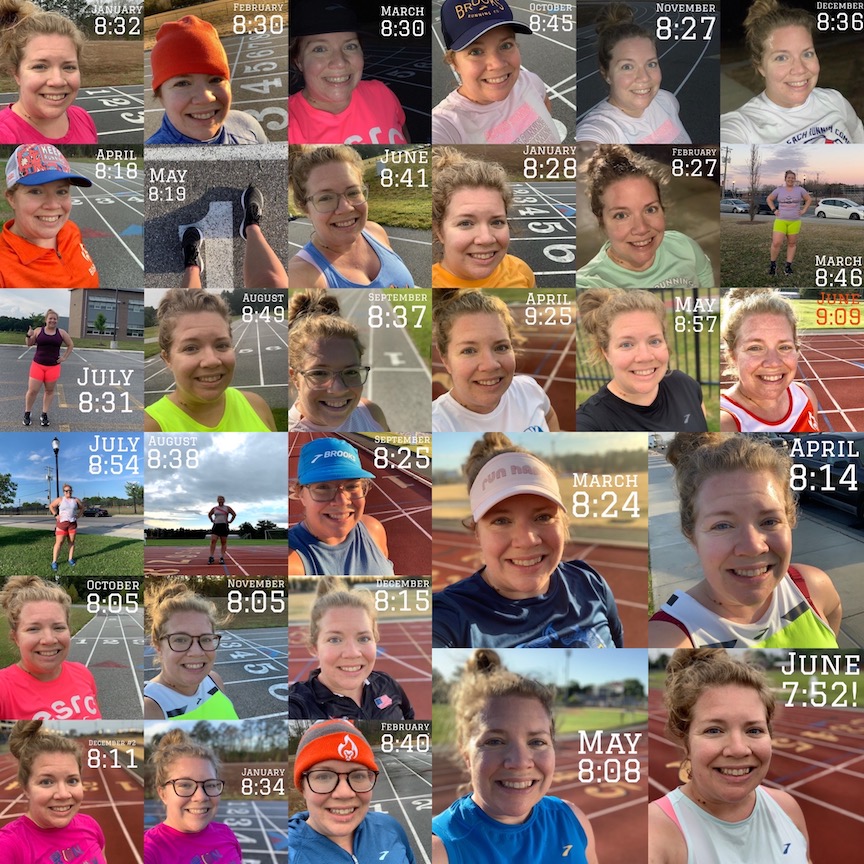
However, this sparked an idea for me — how about running a mile at the beginning of each month, on a track, so the distance would always be exactly the same? Four laps around the track is 1600 meters, which is technically 0.994 mile.
In January 2021, I kicked off this monthly habit, and now I’ve been doing it every month, with no plans of stopping. That first run was 8:32. The goal was sub-8:00.
During the next two-and-a-half years, my times didn’t go in a constant direction. Some were slower, some were faster. In April 2022, what I had to give that day was 9:25. Later that year, in both October and November, I’d run 8:05. I tried four times in December, throwing up during one of the efforts. Usually, the efforts were solo, although my friend Joey came out to pace me during one of the December runs (my first lap was great that day!).
One important aspect to these runs was consistency. Doing this every month helped me know what to expect, and how it felt to go around the track — when I mentally felt I could speed up or even slow down by a hair. Going to a track put me in the mindset of focusing on speed.
Another was a workout I came up with based off of some suggestions my watch had been giving me. I would run 10 segments of one minute all-out, followed by two minutes of recovery. My average for the fast segments for my first attempt at this, in late April 2023, was 8:05. My time for the May 2023 1600 was 8:08.
For my second attempt at this workout, on May 21, my average time for the fast sections was 8:00. For both of these runs, it was empowering to see segment times starting with a “7” and know that I could run at a sub-8:00 pace, even if only for a minute at a time. It also got me used to knowing how this feels.
In May, after I ran the Providence Marathon and with no long race on the horizon, I also started upping my strength training. I still don’t do a ton of strength training, but since I was basically doing none aside from yoga (which I think also helps), I really think this made an impact. I did six DribbleUp classes with my six-pound ball leading up to my sub-8:00 1600-meter run.
My time on June 1 was 7:52. My strategy was to take the first lap fast to bank some time — and confidence. I looked down at my watch and saw that I was under 2:00 for the first lap. I think I saw 1:56; Strava logged 1:57. Either way, that was a big motivator. During other attempts, I’d seen something like 2:05, and while that was still fast for me, I figured there was no way I was going to speed up.
Every time I checked my watch when I crossed that start line during the June run, the number was under what it needed to be to stay on pace — under 4:00, then under 6:00. Once I finished the third lap, I knew I just needed to give it whatever I had and I’d come in under 8:00. The weird thing was that it had actually felt more difficult to run the 8:08 the month before.
I have been doing some fast runs, and two days ago, I ran my fastest two-mile run since February 2020 (18:14). It has been exciting to see my own progress. I’ve also done six DribbleUp classes this month so far.
I’m looking forward to see what my July 1600-meter run time will be; however, it is getting warmer, and I know not every 1600-meter attempt has to be under 8:00. Stay tuned as I try to beat some recent times for other distances later this year!
 She Runs by the Seashore
One thought on “How I ran my sub-8:00 mile”
Comments are closed.